
Discovering SILVER: History and Curiosities About Two Quality Watch Brands
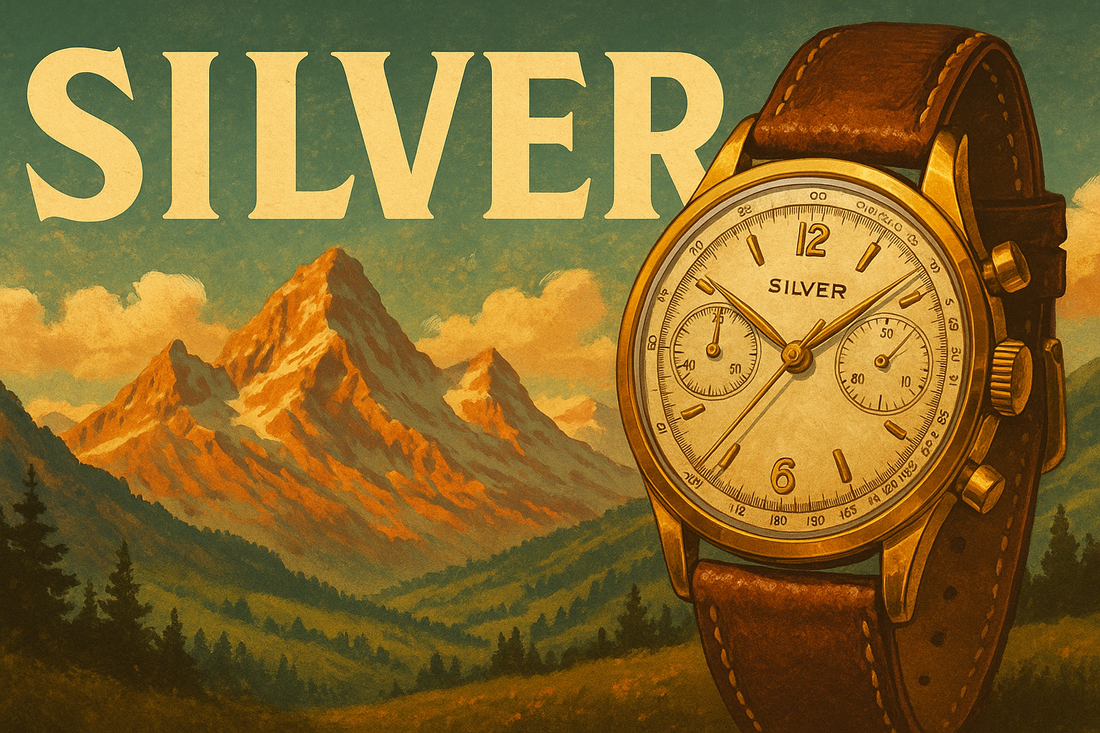
Silver employed Swiss chronograph calibers such as the hand-wound Landeron 248 , enclosing them in precious and elegant cases. The classic models often featured solid gold cases and clean dials, embodying the elegance and prestige of the brand in the 1960s. Since its inception, SILVER has stood out for its quality watches, now sought-after by vintage collectors, and for a fascinating history that unites past and present. In this article, we retrace the history of Silver, a now-defunct watch brand that experienced a brief resurgence in recent times, through family anecdotes, curiosities, and iconic models. Let's embark on a journey through time, from its glorious analog past to the era of independent microbrands, to rediscover a brand that has left an indelible mark on the hearts of enthusiasts.
The origins of the Silver brand: a precious name in 20th-century Swiss watchmaking
Like many post-war watch brands, Silver has its roots in Switzerland, the traditional home of fine watchmaking. Although information is scarce (the brand has been inactive for decades and historical documentation is limited), the name Silver appears in lists of vintage Swiss brands that have now "vanished." Probably founded in the mid-20th century, SILVER chose a simple yet evocative name – “Silver”, like silver – to recall preciousness and shine, values well associated with watches.

During the 1950s and 1960s, Silver produced wristwatches for both men and women, distinguished by classic, elegant lines combined with reliable Swiss movements. A notable example is the 18kt gold Silver Extra chronograph: a refined timepiece with a double chronograph counter, powered by the 17-jewel Landeron cal. L48 movement. , featuring a tachometric scale and gold-plated hands. This model, called "Extra" probably to emphasize its "extraordinary" quality, represented the flagship of Silver production at the time.
But Silver didn't limit itself to chronographs. The brand also created classic and dress watches. For example, there are examples of rectangular gold watches for women, dating back to the early 1960s, equipped with high-quality mechanical movements: one model was equipped with an ETA-manufactured caliber 351 – the same one used in the past by Cartier. This indicates that Silver sourced from high-profile Swiss suppliers, integrating precise and proven calibers into its timepieces. Attention to detail was also evident in components such as the crowns, sometimes embellished with sapphire cabochons. , and in the sober dials with applied indexes. In short, during the golden years of analog watchmaking, Silver built a reputation as a small quality brand, probably distributed on the local European market and appreciated by those seeking classic elegance and mechanical reliability.
The oblivion and disappearance of the historic brand
Like many other medium-sized watch companies, SILVER did not survive the era of major transformations in the industry. Already in the 1970s, with the advent of electronics and the quartz crisis, many independent Swiss brands were forced to close their doors or were absorbed by larger groups. Silver is one of these "vanished brands," and today its name appears only in historical lists and collectors' catalogs. For several decades, therefore, the Silver brand remained shrouded in silence, known only to vintage watch enthusiasts who occasionally came across some vintage piece bearing the word “Silver” on the dial.
Yet Silver's story doesn't end there. Remarkably, over half a century later, the Silver Watch Company name has returned to the watchmaking world thanks to a resurgence in the form of a microbrand. This recent story deserves to be told, as it blends family passion, historical nostalgia, and the challenges of the contemporary market.
The birth of the microbrand: Silver Watch Co.
In 2018, a small group of enthusiasts launched a new independent watch brand and decided to name it Silver Watch Co. Behind this initiative is a fascinating story: a family business created by father and son, united by their love of vintage watchmaking and supported by the advice of Manchester Watch Works. Manchester Watch Works (MWW) was itself an established microbrand, and it provided the Silvers with the expertise and manufacturing network needed to turn a dream into reality. As reported on the enthusiast forum Hablemos de Relojes, the idea for the Silver founders actually stemmed from a family heirloom: an authentic “Milsub” (Military Submariner) that had belonged to their grandfather. Owning that vintage military watch—a rare Navy-issued Submariner, likely from the 1970s—inspired father and son to create a modern homage to that historic timepiece.
The Archetype One project: a passionate tribute to the “Milsub”
The first model born from this adventure is the Silver Archetype One, presented at the end of 2018. It is an automatic diving watch with a design clearly inspired by the legendary Tudor/Rolex “Milsub” – the military Submariner of the 1970s made famous by the French Navy (Marine Nationale) and special forces. Silver Watch Co. wanted to pay homage to that iconic model by faithfully reproducing its aesthetics and proportions, with an almost obsessive attention to detail. The Silver logo stands out on the dial, and although the wording "Archetype One" isn't written (the model name is only indicated on the case back), everything about the watch recalls vintage Submariners: from the geometric indexes and the custard-colored lume treatment (a yellowish "fauxtina" effect) , to the characteristic “Snowflake” hands typical of the Tudor MN .
The steel case has a diameter of approximately 39 mm (39.5 mm including the bezel) and a thickness of around 12 mm, ideal dimensions for evoking vintage proportions without sacrificing robustness. Water resistance is guaranteed up to 300 meters, thanks also to a screw-lock crown (embellished with the Silver logo) protected by "parrot's beak" guards like those on classic Submariners. The movement chosen is the tried-and-tested Miyota caliber 9015 automatic (or the 9039 variant without date, for the "no date" versions). – a reliable and thin Japanese movement, which has allowed the Archetype One to maintain its very slim profile (we are talking about a case thickness of around 10.45 mm, a truly excellent figure for an automatic diver's watch) .
The Archetype One's craftsmanship and quality of detail surprised many enthusiasts. At launch, the Archetype One was priced around $449. , placing it in an accessible price range for a quality microbrand. The watch also included a sturdy Oyster-style steel bracelet, with solid ends and an engraved deployant clasp, which reviewers appreciated for its comfort and finishing (screw-in links and a milled safety clasp). . In short, the Silver Archetype One offered an authentic vintage experience at an affordable cost, garnering praise from those looking for a “nostalgic” yet usable everyday watch.
Successes, hopes, and difficulties: the brief journey of Silver Watch Co.
The launch of the Archetype One – produced in two main variants, one with a blue “Snowflake” dial and hands (a tribute to the Tudor Marine Nationale) and a sterile black so-called “Maxi dial” version inspired by the Rolex Milsub 5513/5517 – was well received in the microbrand community. Building on this initial success, Silver Watch Co. continued to push forward: throughout 2019, the founders presented new concepts and prototypes, eager to expand their line. One of the most intriguing projects was a High Accuracy Quartz (HAQ ) watch, equipped with the ETA Thermoline E64.511 caliber. Silver planned to launch it on Kickstarter with a target price of $329. However, this campaign was unsuccessful : as reported, it didn't reach its goal and the project was canceled midway through. Evidently, the public of Silver enthusiasts, more attached to the vintage mechanical soul of the first model, coldly welcomed the idea of a quartz timepiece, albeit a technologically advanced one.
In parallel, Silver was working on a second automatic model, informally referred to as the “Archetype 1.2”. This time the inspiration was back to the classic Tudor Submariner, with variations in the design to offer something new but in line with the previous success. Prototypes were shown online, and pre-orders were even launched with deposits from enthusiastic customers. It seemed that Silver Watch Co. was ready to take the next step. But unfortunately, at some point in late 2019, the unexpected happened: all pre-orders were refunded, and the project was abruptly halted. The young company decided not to continue its adventure. The reasons? A sort of perfect storm that hit the microbrand: on one hand, the US-China trade war with the resulting tariffs (impacting production costs in Asia), and on the other, supply problems and price increases for mechanical movements by suppliers. All these factors, combined, created insurmountable obstacles for a small, emerging company. It was late 2019, and the Silver Watch Co. adventure lasted just over a year. .
From then on, silence fell again on the Silver name. The official website went from operational to the infamous 404 error. , the brand's Instagram account stopped updating and users' messages went unanswered . In short, Silver Watch Co. became another victim of the difficult jungle of independent microbrands.
Legacy and curiosities about the Silver brand
Although Silver Watch Co. no longer exists in operation, its dual history—that of a historic Swiss brand and that of a modern startup —leaves a fascinating legacy. On the vintage side, Silver timepieces from the 1950s and 1960s are now sought after by collectors of unconventional vintage watches. Lacking the notoriety of the big names, they can often be found at affordable prices, making them attractive prey for those who enjoy unearthing hidden gems of bygone horology. A gold Silver Extra chronograph, for example, offers the allure of a vintage Landeron and a precious metal case at a fraction of the cost of more prestigious brands, while sharing their movement suppliers and build quality. Likewise, Silver dress watches with ETA movements represent pieces of history that speak of a golden age when many small Swiss companies competed to create elegant timepieces for a growing audience.
On the recent microbrand side, the Archetype One and the few units produced remain as cult objects on forums and in enthusiast groups. Every now and then, units pop up for sale on the secondary market, often immediately purchased by those who appreciate their rarity and emotional value. Anyone who was lucky enough to buy a new one back then now owns a small, unique piece from that creative era of microbrands in the late 2010s. The story of Silver Watch Co. is also a warning about how difficult it is to keep a micro-business alive in a globalized world: just think that even a promising design like the Archetype 1.2 was later produced (with some modifications) by another microbrand, Nereus, founded by the owner of Cincy Strap Co., only to then disappear after a short time. A sign that valid ideas always find a way to emerge, but also that competition is fierce and stability elusive.
Ultimately, Silver remains a name that encompasses two histories and two eras, distant yet united by a passion for watchmaking. On the one hand, it evokes the era when the Swiss industry produced refined mechanical timepieces; on the other, it symbolizes today's desire to revive that past through modern homages. It's the story of a brand forgotten by most, yet never truly lost in the hearts of watch lovers: today, it lives on in stories, in blog articles like this one, and on the wrists of a few connoisseurs. And who knows, perhaps in the future the name Silver might return once again, ready to write a new chapter in this saga of precious metal, family ingenuity, and time passing, inexorably yet fascinatingly, on the hands of a clock.
Credits: Watchuseek - Hablemos de Relojes - Two Broke Watch Snobs
1 comment
Peccato ma la speranza e’ dura a morire spero sempre di rivedere in commercio questo marchio di orologeria .Avevo 13 anni quando mi e’ stato regalato il mio primo orologio e dopo 8 anni circa con rammarico l’ho perso oggi ne ho 67 primavere ,capite che adesso avere un orologio Silver e’ una grande gioia per me un ritorno al passato. Un orologio che mi ha scandito il tempo di un lungo periodo importante della mia vita.