

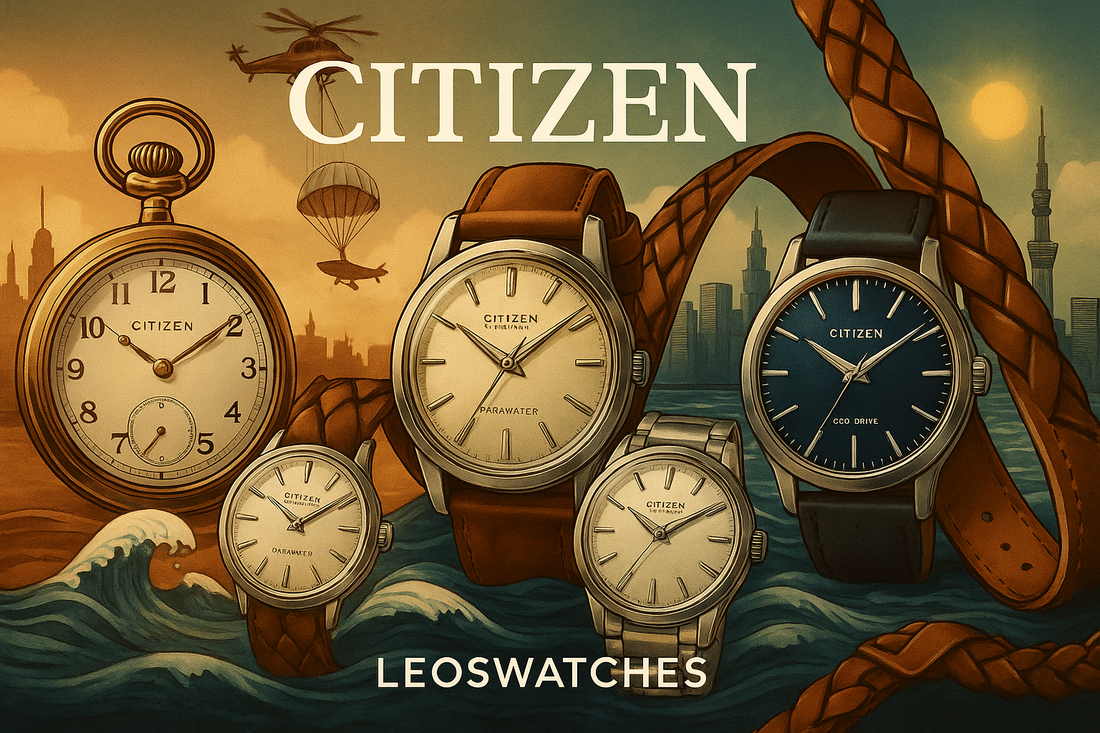
Citizen: The Story of a Legendary Watch Brand
The origins of the Citizen brand (1918-1930)
Citizen's history has its roots in the early 20th century, a meeting of Swiss tradition and Japanese ambition. Not everyone knows that there was also a hint of Switzerland in its early days: Rodolphe Schmid, an enterprising watch importer born in Neuchâtel in 1871, moved to Yokohama in 1894 and became one of Japan's leading watch dealers. Meanwhile, in Tokyo, in 1918, Japanese jeweler Kamekichi Yamazaki founded the Shokosha Watch Research Institute. with the dream of creating high-quality watches that were accessible to all. This small manufacturing workshop marked the beginning of an adventure that would leave its mark on the history of watchmaking.

In December 1924, Shokosha managed to complete its first pocket watch It was an elegant and well-made product, but it lacked a name. That's when Tokyo's mayor, Count Shinpei Gotō, a friend of founder Yamazaki, stepped in: he suggested calling the watch "Citizen" —the English word meaning "citizen"—expressing his hope that it would be a timepiece for as many people as possible, a daily companion beloved by the people. That symbolic name was successful and a few years later, in 1930, when the Shokosha institute officially became a company, it chose Citizen as the company name in honor of that first watch. Thus was born Citizen Watch Co. Ltd., with industrialist Yosaburō Nakajima as president and Kamekichi Yamazaki himself as director. In 1931 Citizen introduced its first wristwatch : a simple and elegant hand-wound mechanical creation, which marked the beginning of the Citizen adventure on the wrists of millions of people.
From the very beginning, the brand's philosophy was clear: "Loved by citizens, working for citizens." Citizen's goal was to put watches at the service of ordinary people, building reliable, precise, and affordable instruments. In the 1930s, the company took its first steps in a market dominated by imported watches, facing initial difficulties but laying the foundation for future innovations. As early as 1932, with favorable exchange rate changes, sales began to grow, and models like the "Citizen F" (a mechanical men's watch) demonstrated the solidity of the young brand, remaining in production until 1957. The path was now set: Citizen was poised to become one of the pillars of Japanese watchmaking.
Innovation and records in the 1950s
After the difficult period of World War II, Citizen returned to focusing its energies on innovation. The 1950s marked the beginning of a race for technological firsts for the Japanese brand, a series of achievements that would distinguish Citizen as one of the most creative and daring manufacturers. In 1952, the company presented the first Japanese watch with a calendar. , a then-rare technical detail that demonstrated the desire to offer useful functions in everyday life. But it was only the appetizer of much more sensational achievements.
The Parashock: Drop-Proof Ruggedness (1956)
In 1956 Citizen launched a model destined to become legendary: the Citizen Parashock, the first Japanese wristwatch equipped with a shock-resistant anti-shock system. Until then, watches had been delicate mechanisms, vulnerable to accidental impacts; with the Parashock, Citizen declared war on breakages caused by falls. To demonstrate the extraordinary robustness of this timepiece, the company organized spectacular public demonstrations throughout Japan: in several cities, Citizen technicians boarded a helicopter and dropped some test Parashocks from a height (about 30 meters!), making them fall before the eyes of the public. One such event took place in front of Kyoto Station, attracting a crowd of gawking onlookers. Miraculously—or rather, thanks to clever anti-shock engineering—the clocks survived the impact unscathed, continuing to tick as if nothing had happened. The demonstration was a triumph: the “parachute” clock had kept its promise, and the Japanese citizens were proud and amazed. From that moment on, the Parashock became synonymous with reliability, forever changing the perception of durability in wristwatches.
The Parawater: The Watch That Challenges the Ocean (1959)
Riding the wave of that success, Citizen then turned its attention to another enemy of watches: water. In 1959, the company introduced the Citizen Parawater, Japan's first water-resistant watch. Until then, getting a watch wet almost certainly meant it would rust or malfunction; with the Parawater, Citizen intended to allow anyone to wear a watch in the rain, at the beach, or during everyday water activities without fear. Here too, to convince the public, extreme tests were conducted that made headlines. In an initial experiment, technicians tied a Parawater to a buoy and set it adrift in the Sea of Japan. Recovered after days of exposure to spray and waves, the watch was found to be in perfect working order. Not content, they organized the so-called "transpacific test" : 130 Parawater watches were attached to floating buoys and left in the open sea of the Pacific Ocean, to be carried by the currents for thousands of kilometers. After almost a year, some of those buoys landed on the coasts of North America and, incredibly, many watches still kept accurate time. It was definitive proof that the Parawater could survive even the most extreme conditions. From that moment on, the term "Waterproof" or "Water Resistant" became a sought-after attribute, and Citizen made it a standard: starting in 1959, the waterproof challenge had been met, and Japanese watches demonstrated that they could compete on equal terms with the global competition on this front as well.
Towards the electronic age and quartz (1960-1970)
In the late 1950s and 1960s, Citizen cemented its reputation in its homeland with elegant and precise watches (such as the famous Citizen Diamond Flake of 1962, the thinnest three-hand watch on the market at the time). ). In 1965, the company achieved a new world record by creating the world's thinnest date watch, measuring just 4.48 millimeters thick—an extraordinary feat of miniaturization for the time. But the decade also saw a momentous technological paradigm shift: the advent of electronics and then quartz revolutionized the industry, and Citizen was among the pioneers of this transformation.
As early as 1966, the Tokyo-based company presented the Citizen X-8 (sometimes called Cosmotron ), the first electronic wristwatch produced in Japan. It was a balance wheel watch electronically controlled by a small transistor – a hybrid timepiece, halfway between mechanical and electronic. The X-8 Cosmotron was a technical success: it could run for a whole year without stopping. , an impressive achievement at a time when most watches had to be wound manually every two days. This “watch of the future” barely anticipated another revolution: that of quartz watches. In 1969, Japan's Seiko introduced the world's first quartz watch, and the watchmaking industry entered the era of electronic precision. Citizen didn't sit idly by: in 1970, it launched its first quartz model, simply called Citizen Quartz. , closely followed by the advanced Citizen Crystron series. These watches offered a precision that was unthinkable just a few years earlier, reducing deviations to a few seconds per month and making the mechanical watch almost obsolete from a functional point of view. The choice to embrace quartz without hesitation allowed Citizen to overcome unscathed the so-called “quartz crisis” that brought many traditional manufacturers to their knees: the Japanese brand was able to combine its mechanical expertise with the new technology, continuing to innovate and present cutting-edge models.
In parallel with the race to electronics, Citizen continued to break records for thinness and experiment with innovative materials. In 1970, for example, it presented the Citizen X-8 Chronometer, which went down in history as the world's first watch with a titanium case. Using titanium (an extremely light and resistant metal, also used in the aerospace industry) for a wristwatch was a bold idea: the X-8 Chronometer applied this glamorous material – which even played a leading role in the Apollo 11 mission to the Moon – to everyday watchmaking, ushering in the era of anti-allergic and ultra-resistant watches. Produced in fewer than 2,000 pieces, those rare titanium cases marked an era, demonstrating once again Citizen's innovative courage. .
In the same years, Citizen developed ultra-precise quartz movements of the highest quality. In 1975, it launched the Citizen Crystron Mega, the world's first watch with an annual accuracy of ±3 seconds, made entirely of 18-karat gold: a masterpiece of technology and luxury. And in 1976, it was "green" ahead of its time with the Citizen Crystron Solar Cell, the first analog quartz watch powered by solar light. . The dial surface of this pioneering model featured solar cells capable of recharging an internal battery, eliminating the need for constant battery replacement. At a time when solar energy was far from commonplace, Citizen had the intuition to harness light as a power source for its watches—an idea that would bear extraordinary fruit in the years to come, laying the foundation for Eco-Drive technology.
The 1980s: The era of professionals and extreme challenges
Having successfully weathered the turbulent 1970s, Citizen entered the 1980s with momentum, becoming one of the most prolific and technologically advanced watch brands in the world. During this decade, the company focused heavily on sports and professional watches, pioneering collections designed for those with special needs—divers, mountaineers, aviators—and pushing the boundaries of watchmaking technology even further.
A flagship was certainly the Citizen Aqualand, launched in 1985 : the first diving watch in the world equipped with an electronic depth sensor. This model, destined to become a trendsetter, could detect water pressure during a dive and display the depth directly on the dial – a revolution for divers, who until then had to rely on separate instruments. The robust and massive Aqualand, with its distinctive sensor on the side of the case, immediately became an icon among diving enthusiasts and inaugurated the successful Promaster Marine series. Many professional and amateur divers in the 1980s proudly wore this watch, knowing they could count on a reliable technological companion on every dive.
In 1989, Citizen hit the mark again with another pioneering product: the Citizen Promaster Altichron, the first wristwatch with a built-in electronic altimeter. Designed for hikers, mountaineers, and outdoor enthusiasts, the Altichron was able to measure altitude thanks to a built-in barometric sensor. It was a true “multifunction” watch ahead of its time: in an era before the widespread advent of wrist-worn GPS, it provided valuable information to those exploring mountains and valleys. With the Aqualand and the Altichron, Citizen demonstrated that watches could be useful and specialized tools for various extreme activities, without sacrificing precision and reliability.
Right at the end of the 80s, in 1989, Citizen gathered all these experiences in a new line dedicated to sports and adventure enthusiasts: the Promaster collection was born, destined to become synonymous with robust and innovative professional watches. The first three Promaster categories covered Sea, Land and Air: the Aqualand for diving (already introduced a few years earlier), the Altichron for altitude, and a radio-controlled Pilot model with world time function for pilots (a precursor to the later Skyhawk and satellite watches). The Promaster family marked the beginning of a new era for Citizen, pushing the brand to continually surpass itself and to celebrate, with every technological milestone, the pioneering spirit that had always distinguished it.
The triumph of Eco-Drive and the quest for absolute precision (1990s and 2000s)
By the 1990s, Citizen was already a global giant, but that didn't slow down. It was in this decade that the company launched its perhaps most famous and commercially revolutionary innovation: Eco-Drive technology. Powering the watch with light, without the need to replace the battery, was an idea that Citizen had been experimenting with since the 1970s (with the Crystron Solar Cell of 1976), but it wasn't until 1995 that this technology reached full maturity and was perfected and relaunched on a large scale under the name Eco-Drive. Citizen's new Eco-Drive watches could use any light source – natural or artificial – to recharge an internal battery, ensuring months (sometimes years ) of operation in the dark on a full charge. The performance was astonishing: just a few minutes of exposure to light were enough for a Citizen Eco-Drive to store enough energy to run for six months in the dark. This combination of practicality and environmental awareness literally made the Eco-Drive phenomenon explode in the 1990s, winning over a wide audience. Citizen's light-powered watches perfectly met modern needs: zero maintenance, zero waste (no batteries to throw away), absolute reliability. Even today, Eco-Drive is the flagship of the brand, and millions of Citizen watches around the world "live on light", faithful to the motto that "light is time".
In 1995, in addition to celebrating its 65th anniversary, Citizen decided to pay homage to its tradition by launching a line of high-end watches that embodied all the brand's values and technologies. Thus was born “The Citizen”, a collection of elite timepieces equipped with the company's most precise movements (quartz calibers with deviations of just ±5 seconds per year) and meticulously handcrafted. The Citizen models – also known in Japan as Chronomasters – offered special guarantees (for example , a 10-year warranty and free maintenance, something unheard of at the time) and were designed to last for decades, reconnecting with the original ideal of “watches for life”. This move marked Citizen's entry into the luxury and collectible segment: the brand demonstrated its ability to compete even in the field of fine watchmaking, while remaining faithful to its vocation as an “everyday” watch.
At the same time, the 1990s saw Citizen push ever further in its pursuit of maximum precision timekeeping. In 1993, the Japanese brand presented the world with the first multi-zone radio-controlled watch capable of receiving time signals from multiple transmitters on different continents. Models such as the Citizen Radio Controlled Wave (and later the Skyhawk AT ) could automatically synchronize with atomic clocks via radio waves, ensuring accurate time on the wrist within one second every 100,000 years. These technologies – combined with Eco-Drive energy – made Citizen watches nearly perfect instruments: never stopped, never late, powered by light and regulated by the atom.
In the first decade of the 2000s, the evolution continued with further milestones. Citizen became a global watchmaking group : in 2008, it acquired the historic American brand Bulova. (thus expanding its presence in the American market) and in the following years also incorporated renowned Swiss brands such as Frédérique Constant (2016) and prestigious movements such as La Joux-Perret/Arnold & Son and Angelis/Ateliers. Furthermore, through a joint venture, the group also acquired Atelier d'Horlogerie di Perrelet, one of the oldest Swiss maisons. We must not forget the Vagary brand, inherited from the Italian group Veglia-Borletti and used by Citizen to cover the entry-level segment with quality quartz watches at affordable prices. These acquisitions demonstrate how Citizen, despite being born and raised in Japan, has become a truly international company, capable of integrating the best of different watchmaking traditions.
On the technological front, the 2010s brought breathtaking new milestones. In 2011, Citizen broke another record by introducing its first satellite watch: the Citizen Eco-Drive Satellite Wave, the world's first watch to receive time from GPS satellites. This light-powered marvel of horological engineering can synchronize with time signals transmitted by satellites orbiting the Earth, automatically adjusting the time and date wherever you are on the planet. With the Satellite Wave, Citizen has literally pushed the boundaries of the planet in pursuit of precision, taking the watch into a new technological dimension. In 2016, the company amazed the world again by introducing the Eco-Drive One, the thinnest solar-powered watch ever created: its movement is just 1 mm thick, housed in a case measuring just 2.98 mm. – an astonishing achievement that earned it a place in the Guinness Book of Records. And in 2018, to celebrate the centenary of its founding, Citizen launched a version of the Eco-Drive One in Super Titanium™. , combining two of its most iconic innovations (solar energy and titanium) in a single commemorative timepiece. In 2019, the maison reached an absolute pinnacle in its quest for precision: it presented the Calibre 0100 Eco-Drive movement, capable of an accuracy of ±1 second per year. This caliber, used in limited edition Citizen watches, is among the most precise self-regulating movements ever made in the world – a true testament to the technical know-how accumulated over a century of history. As the specialized press has emphasized, such a watch needs no external source (neither radio nor satellite) to tell the exact time: all it needs is the beat imparted by its creators, and a little light, to keep it alive. .
Citizen today: tradition, innovation, and endless passion
After more than a hundred years in business, Citizen remains true to the spirit with which it was born. The name itself, “Citizen,” is a constant reminder of its original mission: to serve ordinary people, offering quality and innovation at an affordable price. This philosophy is summed up in the company's current motto, “Better Starts Now.” A simple phrase that embodies a profound belief: no matter who we are or what we do, there is always a way to improve, and the time to start is now. At Citizen, we look to the future relentlessly, with the idea that every innovation is a starting point for reaching a new level of excellence, never a definitive point of arrival. It is no coincidence that the company declares that it never rests on the glories of the past: absolute perfection is not seen as an achievement, but almost as a defeat – because it would mean stopping improving. This constantly evolving approach has allowed Citizen to transcend eras and technological revolutions while always remaining relevant and cutting-edge.
Today, the Citizen brand is a global giant that produces not only watches (over 20 million pieces a year) but also movements, electronic components, industrial machinery, and even jewelry. Yet, despite its size, the company retains a profoundly artisanal soul: in its factories in Japan, there are still "Meisters," master watchmakers who hand-assemble the most complex watches and train the new generations, passing down a unique know-how. The verticalization of production – Citizen builds every single component of its watches in-house, from the gears to the springs, up to the machinery that assembles them – guarantees total quality control and explains the incredible reliability of its products.
Tracing Citizen's history, from the humble Shokosha laboratory in 1918 to the space conquests of the Satellite Wave, one is struck by a common thread: a passion for "democratic" and innovative watchmaking. Each milestone—from the first Citizen watch blessed by Mayor Gotō, to the Parashock launched from helicopters, from the Parawater defying the oceans to the Eco-Drive powered by starlight—tells of a brand that has always reinvented itself without betraying itself. Citizen has made reliable, cutting-edge timepieces available to generations of people, accompanying them in everyday adventures both large and small. In a certain sense, Citizen's history is the story of a century of technical and social progress: the watch that went from being a luxury for the few to becoming a commodity for the many, then an instrument of scientific precision, and finally a symbol of sustainability and global connectivity.
And while time passes inexorably, on the wrists of millions of "citizens" around the world there is a timepiece that continues to tick with dogged precision: it is a Citizen, heir to a century-old tradition but always projected towards the future. Better starts now – says the company motto. And it makes you think that, as long as there is a "now" to improve, Citizen will continue its race, one second at a time, with the same passion as the first day.
credits: Wikipedia - citizen.it - citizen.co.jp - citizenwatch-global.com
Original, unmodified image of the Shokosha Watch Research Institute headquarters, from the official website www.citizen.it