

Kienzle 1822: The History of a Legendary Watchmaking Brand
Share
Kienzle is much more than just a watch brand: it is a true piece of watchmaking history, being the oldest German watch brand still in existence, with origins dating back to 1822. Born in the heart of the Black Forest in Germany and reborn in Italy after the Second World War, this brand has spanned two centuries of innovation, challenges, and successes. In this article, we passionately retrace Kienzle's extraordinary history—from its humble artisanal origins, through pioneering industrialization and curious anecdotes (like a traveling bus used as a showroom in the 1930s!), to its current market positioning. Prepare to journey through time to discover how Kienzle 1822 has combined German watchmaking tradition with Italian creativity, remaining relevant and fascinating for enthusiasts even today.
The origins in the Black Forest (1822-1900)
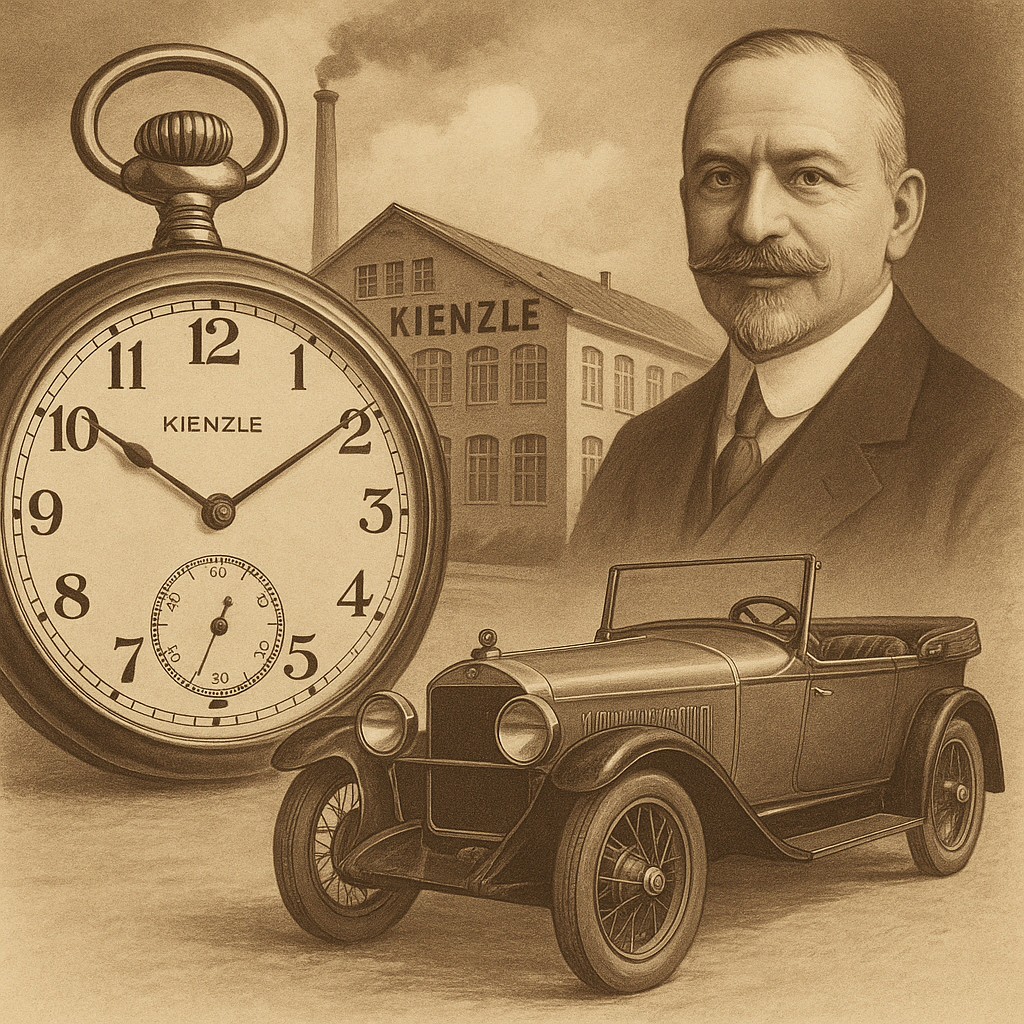
Kienzle's story begins in 1822 in Schwenningen, a town in the Black Forest in southern Germany, then in the Kingdom of Württemberg. Here the clockmaker Johannes Schlenker opened a small artisan workshop, specializing in the production of pendulum clocks and wall clocks typical of the local tradition. Over the decades, thanks also to the entry of Schlenker's sons into the company around 1855, the brand began to expand and gain popularity even outside the regional borders. By the mid-nineteenth century, the factory already had around twenty employees and produced around 20,000 pendulum and wall clocks per year, an impressive number for the time. .
In 1883 a fundamental turning point occurred: Jakob Kienzle, a young entrepreneur and son-in-law of the founder Schlenker, joined the company. . Soon after, Jakob, together with his brother-in-law (Schlenker's heir), took over the company and renamed it Schlenker & Kienzle. About a decade later, in 1897, Jakob Kienzle became the sole owner and permanently changed the company name to Kienzle. . In addition to his name, Jakob brought an innovative spirit: he introduced modern production methods inspired by the "American system" into the company, standardizing the production of single parts in series ready for assembly. This intuition for large-scale industrial production allowed for significant cost reductions and increased volumes, giving Kienzle a competitive advantage while other competitors struggled. Towards the end of the 19th century, thanks to these innovations, Kienzle even managed to survive a serious economic crisis caused by rising raw material costs and a shortage of skilled labor. .
With Jakob Kienzle's visionary approach, the company experienced rapid growth. By 1899, the factory employed around 400 workers and was among the first to adopt electric lighting in its production departments. In those years , over 160,000 clocks (including alarm clocks and wall clocks) were produced each year. The expansion pushed Kienzle to look at international markets: at the beginning of the twentieth century branches were opened in Milan, London and Paris to distribute the products in the major European cities. The fame of the German manufacturer grew in step with its catalogue: alongside the classic clocks, the first travel and pocket watches appeared, as well as the first experiments with wristwatches (initially for women) even before the First World War. In 1904 Kienzle launched its first pocket watch with great success, characterised by a clean and robust design, which immediately became distinctive of the brand. Shortly after, in 1905, it was the turn of travel alarm clocks, products that were in great demand in a Europe where mobility was increasing.
Innovation and global success between the wars (1900-1930)
Since the early 1900s, Kienzle has shown an incredible ability to innovate and adapt to market needs. In 1910, the company began producing its first car clocks, thus opening a new chapter in its history. These were small dashboard clocks, resistant to dust and humidity, designed to be mounted on motor vehicles. Even the prestigious Rolls-Royce was the first car manufacturer to equip its models with a Kienzle clock: a manually wound timepiece with an 8-day duration, waterproof and dustproof, installed on the dashboard as a luxury feature. This record marked the beginning of a long-lasting partnership between Kienzle and the automotive industry: in the following years, numerous brands – from Porsche to Mercedes-Benz, from BMW to Volkswagen – chose Kienzle's tools to equip their cars. Demand for Kienzle watches grew dramatically: by 1913 the company was producing 3 million watches a year and had around 2,500 employees, establishing itself as one of the largest manufacturers of “mass” watches in Germany, on a par with Junghans.
During the 1920s, alongside series production, Kienzle continued to distinguish itself through the high quality and reliability of its mechanical movements. One of the most famous was the caliber 051a50, produced in numerous variations and renowned for its robustness and precision. In 1931, the company launched its first Art Deco-style wristwatch, which was water-resistant and powered by the Kienzle caliber 051 movement, which became a bestseller of its time. The following year, in 1932, the first legendary Kienzle aviation watch was conceived and produced. This pioneering timepiece, designed for pilots and onboard instruments, inaugurated the Kienzle tradition in the field of aviator watches, which was destined to continue for many decades. In this vein, a special pilot's watch with an 8-day power reserve was also created, designed to last a long time and be reliable even in extreme conditions. .
In these years Kienzle did not fail to amaze even on the marketing front. To promote its products, in fact, it adopted an avant-garde idea: an enormous mobile showroom known as the “Kienzle Bus”. Between 1937 and 1938, two futuristic buses on Mercedes chassis were set up, 16 meters long and weighing 11 tons, which served as a traveling exhibition. The interior of the vehicle housed a real exhibition of watches aimed at professionals, while along the sides were set display cases with watches on display for the public. These buses were even equipped with self-contained generators, radios, gramophones, and even sleeping places and water tanks, allowing them to tour cities and trade fairs, showcasing the excellence of Kienzle products to the world. The Kienzle Bus, with its glossy black exterior featuring the “Kienzle Uhren” logo and a large clock on the side, aroused enormous curiosity and became a piece of history in itself: a very rare example of traveling advertising in the 1930s. This far-sighted move by Kienzle was so effective that it is still remembered with admiration by watchmaking history enthusiasts today.
Kienzle and Italy: the birth of SIOK (1933-1945)
In 1933, Kienzle decided to consolidate its presence in one of its most important foreign markets, Italy. That year, a branch was opened in Milan, formalized as SIOK – Società Italiana Orologi Kienzle, with the aim of assembling movements and producing cases for watches destined for the Italian market. The Milan office, led by brothers Massimo and Riccardo Weyler (technicians who had already worked at the parent company in Germany), allowed Kienzle to further establish itself in Italy, taking advantage of local taste and getting closer to the customers of the Bel Paese. Unfortunately, the war events abruptly interrupted this expansion: with the outbreak of the Second World War, the Italian branch had to close and the connections with the parent company were interrupted. .
Meanwhile, during the conflict, Kienzle production in Germany was put to work for the Nazi war effort—a dark but significant chapter. The factory also employed forced laborers from occupied countries. and supplied various timekeeping instruments and watches to the German armed forces (Wehrmacht and Luftwaffe). In particular, Kienzle produced 8-day cockpit chronographs installed on military aircraft such as Messerschmitt and Heinkel fighters. , as well as robust wristwatches and pocket watches for soldiers and officers. A curious anecdote from this period concerns an exclusive world clock produced by Kienzle in 1939 : commissioned by members of the regime, it was designed as a gift for Adolf Hitler's 50th birthday. The watch featured a world map on its dial, and a crescent-shaped window displayed the world's time zones—a unique piece of great symbolic and technical significance for its time. Although associated with a dark chapter in history, this watch remains a testament to the Kienzle manufactory's ability to create special and extraordinary creations.
From the post-war period to the rebirth: the 1950s and 1960s
With the end of the war, Kienzle literally had to rise from its ashes, at least as far as its presence in Italy was concerned. It was in Milan that the Weyler family spearheaded the revival: Massimo and Riccardo Weyler managed to take over the Italian Kienzle branch, demonstrating great entrepreneurial courage in a very difficult period. Under their leadership, the Società Italiana Orologi Kienzle gradually resumed operations, focusing increasingly on wristwatches – which had meanwhile become the dominant product in the sector, supplanting pocket watches. In 1954, the transition to the second generation took place: cousins Gerhard and Gunther Weyler took over the leadership of the Italian company, consolidating the family bond at the helm. Thanks to the Weylers' determination, Kienzle Italia (as it would later be renamed) was able to prosper and align itself with the parent company's production, helping to spread the brand in our country.
Meanwhile, the German parent company also experienced a new production momentum. Already between the 1940s and 1950s, Kienzle had launched a myriad of innovative models and instruments. The Kienzle Signal was a famous one, a mechanical 60-minute countdown timer introduced during that period and available in numerous versions. On the wristwatch front, in the mid-1950s, sportier and more modern lines were born, such as the Alfa, the Markant and the Life, equipped with screw-down cases, excellent readability and anti-magnetic effects. These were robust timepieces, designed for everyday use, which achieved success due to their reliability. In those same years, Kienzle also presented the “Volks Automatik”, literally the people's automatic : a self-winding wristwatch (based on the Kienzle 57 series movement), with a bidirectional rotor and 17 jewels. The idea was to offer an automatic watch accessible to the general public, much like the Volkswagen was for cars. However, the Volks Automatik proved to be quite expensive compared to the manually wound version, which is why it did not enjoy widespread diffusion and Kienzle decided not to develop further in-house automatic movements beyond that series. . In parallel, in 1948, to celebrate its international success in mechanical watchmaking, Kienzle launched the famous Bauhaus line, characterised by an elegant and minimalist aesthetic inspired by the German art and design school of the same name. This mix of models – from sporty and robust to those with a refined taste – demonstrated the brand's versatility in responding to the public's diverse needs.
Another field in which Kienzle dominated for decades was that of interior and vehicle clocks. Until the late 1960s, the brand held a virtual monopoly in the production of car clocks, supplying dashboard instruments for prestigious manufacturers such as Mercedes, Porsche, Audi, Aston Martin, Bentley, and Jaguar, in addition to the aforementioned Rolls-Royce and BMW. . Kienzle branded table alarm clocks and wall clocks also continued to be produced in large numbers: a landmark model was the Kienzle Duo, a table alarm clock from the 1930s that achieved great popular success. In the 1960s, however, a particular round table clock became famous, featuring a globe and various time zones on its dial (the design derived from the 1939 project intended for Hitler, which we mentioned earlier). Another interesting piece presented in that period was the Heliomat, a solar-powered table clock, a forerunner of technologies that would explode in the following decades.
Watches like this embodied the brand's philosophy: German reliability and functional design, with a robust case, antimagnetic movement, and a simple style suitable for everyday use. The Alfa line, along with the contemporary Markant and Life, demonstrated Kienzle's commitment to creating modern and practical timepieces for the mass public. Details such as the screw-down case back, the easily legible dial and the in-house movements with few jewels but highly robust testified to the typical constructional care of the Schwenningen manufacture. Thanks to these models, in the 1950s and 1960s Kienzle consolidated its reputation as a manufacturer of “honest” and resistant watches, trusted companions in the daily lives of many people.
From the quartz era to technical evolution (1970-1990)
Entering the 1970s, the world of watchmaking underwent epochal changes with the advent of quartz technology. Kienzle, building on its history, once again demonstrated its ability to adapt. On the design front, the Aristokrat collection was introduced in the early 1970s, with a decidedly contemporary feel: watches with distinctively shaped cases—rectangular or square with rounded corners—and a bolder, more "fashionable" style compared to the rigor of the past. . At the same time, the Sport series, which had already started in the 1960s, continued, characterised by robust cushion-shaped cases and a much-appreciated sporty look. .
1972 was another memorable year for Kienzle: the company introduced the Heliomat, the brand's first solar wristwatch, pioneering the use of solar cells as a power source. . In the same period, Kienzle also put its first quartz movements into production and was among the first companies to offer a quartz travel alarm clock with an LCD display, intercepting the electronic revolution in watchmaking. Traditional mechanical production, however, was not abandoned: throughout the 1980s Kienzle continued to produce mechanical wristwatches alongside alarm clocks, pendulum clocks and wall clocks, maintaining a wide range to satisfy every need. .
An emblematic product of the 1980s was the Kienzle Satellite, a radio-controlled table clock. Initially housed in a wooden case, the “Satellite” ensured absolute precision thanks to radio signal synchronization, and was a notable success among the technology-loving public. Curiously, it was precisely in that period that the Italian branch (SIOK) expanded its catalogue by also distributing pendulums and table clocks from other prestigious brands, such as the French L'Epée and the German Kundo, proving the reputation and commercial network that Kienzle enjoyed in Italy. .
In 1992, Kienzle celebrated its 170th anniversary in style: a limited-edition automatic chronograph featuring a complete calendar was created for the occasion. This commemorative watch was powered by the excellent Valjoux 7751 movement and paid tribute to the brand's technical heritage, combining useful complications (such as a complete date and moon phase) with the robustness of a sports timepiece. A few years later, in 1995, Kienzle made headlines around the world for an absolute first: the creation of the Hyperbar Extreme, a professional diving watch declared as the most resistant in the world. The Hyperbar Extreme boasted water resistance up to 1200 bar, equivalent to a depth of approximately 12,000 metres. It was a level far beyond real needs (no human being can descend to those depths), but it demonstrated the company's desire to push the limits and also to excel technologically. With the Hyperbar, Kienzle rightfully entered the elite group of ultra-technical diver's watch manufacturers, alongside very few other brands capable of similar feats.
These technical achievements should not obscure the fact that the sector also faced commercial and reorganization challenges during the 1990s. Kienzle Uhren GmbH, the German headquarters, was acquired in 1997 by an industrial group (Highway Holdings) and then regained independence in 2002 with the founding of Kienzle AG in Germany. . The strategic direction, however, was about to change course, shifting significantly towards Italy.
Kienzle Today: German Tradition in Italian Hands (2000-present)
In September 2002, the Italian Kienzle Watch Company officially changed its name to Kienzle Italia, effectively confirming that the epicentre of the brand's watchmaking activity was now firmly established in our country. In the same year, the historic German headquarters was moved from Schwenningen to Hamburg, in an attempt to revitalize the brand internationally through Kienzle AG. However, fate had mixed fortunes in store: while in Germany the company would later diversify its production into consumer electronics and other devices, it also encountered financial difficulties (until it declared insolvency in 2010 and a further bankruptcy in 2014). In Italy, Kienzle found a second life and a renewed identity. Under the guidance of the Weyler family – with Emanuel Weyler, the third generation, firmly in charge since 2002 – Kienzle Italia has continued the watchmaking tradition by focusing on the Italian market and on a clearly defined product philosophy.
Today Kienzle Orologi can boast a large collection of wristwatches that combine the best of two worlds: German build quality and robustness blend with modern Italian design, resulting in unique timepieces. The company's stated mission is to create watches that achieve the perfect balance between high quality, successful contemporary aesthetics and competitive prices. In other words, Kienzle wants to offer “ the dream that is no longer forbidden ” to all enthusiasts: watches of a high standard but accessible, so that beauty and precision are not reserved for a select few. This strategy has proven successful, allowing the creation of collections with a contemporary style and in line with Italian trends, yet always faithful to the brand's original spirit. Kienzle currently has approximately 1,500 active stores in Italy, A widespread network of watch and jewelry stores that distribute its products nationwide. This strong position in the domestic market has been built over the years thanks to a constant presence and the trust earned by retailers and customers.
In terms of products, Kienzle today offers several watch lines, designed to satisfy different tastes while maintaining a common thread. The main collections include:
- Classic – an elegant and timeless line, which includes refined timepieces with a classic taste. One example is the Mechanical Edition, a watch with a power reserve, retrograde date display, and a visible heartbeat on the dial (powered by a Chinese-made Sea-Gull automatic caliber). The Classic models recall the brand's historical heritage, with clean designs and traditional details.
- Aviator – watches inspired by the vintage pilot watches that Kienzle has been producing since World War II. They feature highly legible dials, often with vintage elements such as large numerals and luminous indexes, evoking the instruments on vintage aircraft. In 2022, to celebrate the 200th anniversary of its founding, Kienzle launched a special Aviator model, with an automatic movement and the number "200" prominently displayed on the dial, commemorating the historic anniversary. .
- Diver – the line dedicated to diving watch enthusiasts. Standouts here include the Poseidon brand (part of the Kienzle group), robust waterproof watches designed for aquatic adventures, and the Ares model, a professional diver's watch capable of reaching depths of 1,000 meters. These diving timepieces combine impressive technical features (such as a helium escape valve, unidirectional bezel, and powerful luminescence) with an eye-catching, contemporary design.
- Hommage – a collection that pays tribute to the brand's history, revisiting past models with a modern twist or celebrating specific historical anniversaries. This line often features limited editions or special collector's pieces, embodying the essence of Kienzle with retro details and archival aesthetic references.
- Pocket watches and other complications – Kienzle has not forgotten lovers of the more classic style: even today it offers pocket watches in various shapes, keeping alive a tradition that dates back to its origins. The catalog also features watches with advanced complications (such as complete calendars, moon phases, and collaborative tourbillons) and special limited-edition series, demonstrating the brand's continued experimentation while remaining true to its heritage.
Despite being a bicentennial brand, Kienzle continues to innovate, offering watches that are in step with the times yet with a soul that harks back to its long tradition. The trident on the Poseidon's dial is a symbol of conquering the deep, but it could also represent the determination with which Kienzle has weathered the storms of history unscathed, each time emerging stronger than before.
In conclusion, the history of Kienzle is a fascinating journey through two centuries of watchmaking. From a small workshop in the Black Forest to a pioneer of industrial production, from a supplier of the most luxurious vintage cars to a protagonist of the quartz era, up until its Italian rebirth, this brand has demonstrated an extraordinary capacity for resilience and adaptation. Today, as in the past, wearing a Kienzle watch means wearing a piece of history on your wrist—the story of a brand that, founded in 1822, has kept its mechanical heart alive through the generations, combining German precision and Italian passion. And who knows what other exciting pages it will add to the great book of time…
Fun fact: Kienzle is the oldest watch brand in Germany (over 200 years of history); in the 1930s, it promoted its products with a huge traveling bus equipped as a showroom; its dashboard clocks adorned Rolls-Royce and Bentley cars as early as 1910. ; produced sundials and radio-controlled watches among the first in the world ; and even a table clock as a birthday present for Hitler in 1939 Few watch brands can boast such a wealth of anecdotes and such a strong connection between past and present – Kienzle is undoubtedly one of them, a legend that continues to tick tirelessly.
Credits: Wikipedia - Kienzle.it