
Lanco – Rise, glory and rediscovery of a legendary brand
The Origins of Lanco: From Chicory to Watches
Imagine a small Swiss village in the second half of the 19th century. In Langendorf, in 1873, Colonel Johann Viktor Kottmann converted a chicory factory into a watchmaking workshop, laying the foundations for what would become the Langendorf Watch Company. The beginning was not easy: around 1880, the company nearly went bankrupt due to organizational problems and even episodes of alcoholism among the workers. Yet, from this crisis emerged an extraordinary story of resilience and innovation. Johann Viktor and his son Karl reorganized production, hiring expert watchmakers from French-speaking Switzerland, and above all, they cared for their community of workers. Langendorf became an example of corporate social responsibility ahead of its time: housing and schools were built for the workers, electric lighting was installed in the village, and even a mutual aid society was founded that still exists today. Within a few years, the factory flourished again: by the late 1880s, renamed the Langendorf Watch Company (LWC), it employed hundreds of employees and produced thousands of movements a day, probably becoming the world's largest manufacturer of its time. . Langendorf timepieces thus began to make a name for themselves, a prelude to the birth of a brand destined to become legendary: Lanco.
The birth of the brand and the golden age of Lanco
For decades, the Langendorf Watch Company produced movements and watches for third parties, perfecting its craftsmanship. During the 1930s, it also created specialty watches, such as models for military aviation and even original "jump hour" watches. But it was in the post-World War II period that Langendorf experienced its golden age: during the 1950s, the company, led by the Kottmann family for generations, took the decisive step of launching its own brand. Thus was born Lanco – a term derived from the first letters of LANgendorf Watch Company – destined to identify the company's flagship watches. The Lanco collection debuted in the late 1950s and immediately achieved enormous success. .
At the height of the economic boom, Lanco became synonymous with affordable Swiss quality. An advertisement of the time boasted that "a Lanco was sold every five minutes." – a sign that these watches were extremely popular and loved by the general public. The secret to their success? A combination of competitive pricing and reliability, the fruit of Langendorf's extensive manufacturing experience. The movements were designed and built in-house, with attention to details that were not taken for granted at the time: for example, many Lanco models from the 1950s featured radium-luminescent indexes and hands, ensuring legibility in the dark – a valuable detail that many competitors didn't offer. All this was housed in sturdy yet elegant cases: as early as 1945, Lanco was offering watches that were large (36-37 mm) for the time, anticipating future tastes. In short, a Lanco on the wrist in the 1950s often represented the first "true" Swiss watch for ordinary people – a small, accessible luxury, a symbol of status and technological progress during the boom years.
Lanco Mod. 11 and De Luxe: the people's watch

The model that more than any other embodies Lanco's triumph in the 1950s is the legendary Lanco Model 11. Introduced in the second half of the 1940s, the “Mod. 11” is a simple and robust time-only watch, offered at a competitive price but with high quality standards. The 37 mm chromed metal case – unusually large for the time – housed a mechanical manufacture movement, initially the Langendorf caliber 1222, later evolved into the 1305. The latter introduced important technical improvements: greater resistance to magnetic fields, an anti-shock device and an increase in the oscillation frequency. Visually, the Mod. 11 featured a clean, legible dial, often featuring applied Arabic numerals and radium hands for night-time reading. A more refined aesthetic version, the Mod. 11 “De Luxe”, was also created, recognizable by its dial decorated with a fine honeycomb guilloché pattern that gave it a luxurious appearance. This variant combined elegance and functionality, retaining the mechanical essence of the standard Mod. 11. Thanks to its reliability and excellent value for money, the Lanco Mod. 11 became a bestseller and a faithful companion for thousands of customers. For over a decade – until the early 1960s – a Model 11 was sold every few minutes somewhere in the world, marking the time of an entire generation.
Alongside the Mod. 11, Lanco was able to diversify its offering already in the 1950s. One example is the Lanco Sport, essentially a variant of the Mod. 11 equipped with "technical" features: waterproofness, shock resistance and anti-magnetism. Designed for a more dynamic use, the Lanco Sport anticipated the concept of a versatile sports watch long before it became a widespread fashion. It was also during this period that Lanco began to look overseas: towards the end of the 1950s, the brand successfully landed in the United States, even opening its own factory overseas to assemble watches for that market. . In America too, Lanco timepieces were appreciated for their affordable quality, helping to spread the brand's name on an international scale.
The Lanco-Fon and the challenge of wrist alarms
Among the most curious and innovative models launched by Lanco during its golden age was the Lanco-Fon, presented in 1950. It was a small masterpiece of micro-mechanics: a wristwatch with an integrated mechanical alarm. At the time, wristwatches with alarms were an absolute rarity – the Vulcain Cricket was practically the only other famous example – and Lanco decided to take up the challenge. The Lanco-Fon featured a manufacture caliber (the Langendorf 1243) with a complex striking mechanism. Technically, it operated via a second barrel and an internal hammer that vibrated the case at the set time, emitting a characteristic buzzing sound. To make everything more intuitive, Lanco introduced an ingenious idea: a small window at 12 o'clock with a disc that indicated the alarm status – visible red meant the alarm was on, white meant the alarm was off. This detail allowed the owner to know at a glance whether the alarm was active, a much-appreciated convenience. The Lanco-Fon, with its name referencing the sound (“-fon”), quickly became a coveted object for lovers of complicated watches. While it didn't have the resonance of its rival Vulcain Cricket, it represented Lanco's attempt to compete in terms of innovation. Even today, finding a working one is a source of excitement for vintage watch collectors: the crackling sound of its alarm immediately transports you back to the mid-twentieth century, when waking up with a watch on your wrist seemed like a little piece of futuristic magic.
Barracuda and Seaborn: The Age of Dive Watches
With the arrival of the 1960s, the world of watchmaking saw the emergence of a new trend: the diving watch. Lanco, always attentive to market developments, did not stand idly by. At the height of the "diver's fever," it presented its model destined to become legendary: the Lanco Barracuda. The Barracuda – whose name evokes the fast tropical fish – was available in various versions, both with a traditional “skin diver” type external rotating bezel and with a co-axial internal bezel (in the Super Compressor style). All versions shared a fundamental element: exceptional dial readability, with generous indexes and thick hands filled with luminescent material. The dial often featured the word “Barracuda” in a distinctive cursive font, which itself became part of the watch’s iconic design.
From a technical point of view, the Lanco Barracuda boasted the features required of a true diving watch: a robust steel case, a screw-down case back engraved with the words “ Guaranteed 20 atmospheres, tested 30 ” (indicating water resistance up to 200 metres, tested up to 300). , a locked crown and a reliable automatic movement. It was also one of the last Lanco models to feature a manufacture calibre, the self-winding Langendorf 1146 with date. , before the company began adopting external movements in subsequent productions. The Barracuda thus combined Lanco's construction tradition with new sporting requirements, resulting in a timepiece both aesthetically and technically fascinating.
Introduced in the late 1960s, the Barracuda immediately became Lanco's flagship model in the sports field and is today considered the most sought-after and valued Lanco model on the vintage market. Alongside the Barracuda, Lanco also offered the Seaborn model, another diver's watch available in both a fully waterproof version and a water-resistant version (resistant to splashes and surface swimming). The Seaborn was distinguished by its cushion-shaped case, which was very popular in the late 1960s and early 1970s. While not reaching the legendary status of the Barracuda, the Seaborn enriched the Lanco range by offering stylistic alternatives to divers, with a square, modern design that nodded to the trends of the time.
Automatics, chronographs and creative designs
In the same years, Lanco expanded its catalog with other new products, demonstrating versatility and creativity. Already in the 1950s, it had introduced automatic movements: the famous Lanco-Matic, a model equipped with a self-winding movement with a "hammer" (the balance wheel winding mechanism, a precursor to today's rotors). This marked Lanco's entry into the era of affordable automatic watches, allowing customers to avoid the hassle of daily manual winding. Over the next decade, Lanco further refined its automatic calibers – as seen with the Barracuda – but to optimize costs, it also began using automatic movements derived from Tissot, after joining the SSIH group (which we'll discuss shortly). .
Lanco's creativity was also expressed in the design of the dials. A curious example is the so-called "Disco Volante", a nickname given to some models from the 1950s with a large central flower-shaped decoration that recalled, precisely, a space flying saucer. It was a time when science fiction was influencing popular taste, and Lanco did not fail to add a touch of originality to its flagship timepieces. Other models, such as the Lanco Micro-Tecnic, featured geometric diamond-shaped dials, anticipating the optical style that would later explode. There were even customized editions for the Italian market, commissioned by the importer Sarcar, with unique details intended for our demanding public. .
The catalog also included a Lanco chronograph : despite not having a high-sounding name, in the 1960s the maison produced some two-counter chronographs (bi-compax), relying on calibers from specialized suppliers. In particular, it used Landeron and Valjoux movements (such as the famous 7733) to ensure precise performance in its chronographs. Towards the end of the 1960s, to keep costs down, Lanco came up with an economical chronograph with an EB 8420 pin-lever movement (hands without jewel anchors). , a technical compromise intended for those seeking a watch with a chronograph function at a minimal cost. This also demonstrates Lanco's willingness to explore all market segments, from high-end products to the most popular ones, in order to remain competitive in a rapidly changing industry.
The myth of Lanco: prestige and culture during the boom years
During its heyday – roughly from the mid-1950s to the mid-1960s – Lanco became a minor legend in popular watchmaking. While it didn't have the prestige of historic brands like Omega or Longines, it managed to win the hearts of a vast audience. In many European countries, including Italy, giving a Lanco for a special occasion (such as a graduation, an anniversary, or retirement) was a gesture full of meaning: it meant giving a beautiful, useful, and long-lasting object, an expression of taste and attention to Swiss quality. It's no coincidence that many Lancos bear dedications engraved on the case back – a sign of how much they were chosen as celebratory and sentimental watches. For example, a delicate women's Lanco from the 1950s, preserved in a collection, is engraved with the date 1956, marking a retirement gift. This demonstrates how this brand had entered the daily and sentimental lives of many people.

Culturally, Lanco fully embodied the spirit of its time. In the 1950s, the advertising message “Lanco, Universally Famous” extolled the technological pride of a Swiss watchmaking industry that exported precision everywhere. The design of its watches, from the classic Mod. 11 to the imaginative “Disco Volante,” reflected the tastes and dreams of the era: the elegant sobriety of the post-war era, the passion for space, the desire for dynamism. Even the evolution of the Lanco logo reflected cultural changes: initially a simple star to evoke the idea of light and guidance; then, in the 1960s, a more modern cursive “L,” and finally an “L” inscribed in a circle, almost as if to symbolize a small, stylized watch. This last logo, nicknamed “Circle-L,” became the best-known and accompanied the brand throughout its peak years. Seeing it printed on store signs or packaging meant immediately recognizing a Lanco product.
Even from an industrial point of view, Lanco represented excellence: in 1959 the Langendorf factory employed around 1500 workers and produced more than 4000 watches per day. An imposing new 10-story factory dominated the village, a concrete symbol of the boom (today transformed into a supermarket). . Lanco was therefore, for the Swiss watchmaking industry, a source of national pride and proof of how mass production and quality could be combined. Its presence on the market – alongside the most prestigious brands of the Omega-Tissot group – served to serve the middle-class segment with reliable products and attractive designs. In a certain sense, Lanco democratized the Swiss watch, bringing it to the wrists of office workers, workers, and students, not just managers or wealthy professionals. This is perhaps the brand's most important cultural legacy: having made the "precision timepiece" an accessible, widespread, and socially significant commodity in a period of great change.
Decline and sunset: the end of an era
As in many industrial sagas, after the peak comes the time for difficult challenges. For Lanco, signs of crisis began in the mid-1960s. In 1964, the Langendorf Watch Company initially joined the SGU (Swiss Watch Industry Association), a group of Swiss watchmaking factories. The following year, 1965, a crucial step took place: Lanco was acquired by the powerful SSIH (Société Suisse pour l'Industrie Horlogère). , the group that already controlled Omega, Tissot, and other brands. Lanco essentially entered the orbit of the future Swatch Group (which would be created in 1983 from the SSIH–ASUAG merger). This could have guaranteed financial solidity and industrial synergies, but it also marked the end of the brand's independence. According to some sources, the actual integration into SSIH occurred a few years later, in 1971. , perhaps following the sudden death of the brothers Hans and Guido Kottmann, the last heirs of the family, in 1964-65 .
Within SSIH, Lanco was positioned as a lower-middle-range brand, below Tissot and Omega. The group's goal was to leverage Lanco to conquer the mass market, exceeding one million watches sold per year. At first, the strategy seemed to work: thanks to Lanco's contribution, SSIH reached 1.7 million units annually by 1970. However, in those very early 1970s, the Swiss watch industry was swept away by an epochal revolution: the advent of precise and affordable Japanese quartz watches, which triggered an unprecedented crisis for traditional manufacturers.
SSIH found itself in financial difficulties and had to implement drastic rationalizations. In 1972, it was decided that Lanco would cease in-house production of movements : from now on, it would use calibers supplied by its major subsidiaries (Omega and Tissot) or by external suppliers, focusing only on the assembly and production of dials and components. This was the beginning of the end. Deprived of its manufacturing soul, Lanco gradually lost its identity and prestige. There were attempts to keep the brand alive by adapting it to the times: in the second half of the 1970s, Lanco watches appeared with bolder designs and larger sizes (anticipating the oversize trend). , as well as digital LED/LCD models with the Lanco logo on the dial Lanco even fitted the revolutionary Tissot Astrolon plastic movement to some models, a sign of extreme experimentation. But these were the last gasps.
Towards the end of the 70s, despite some new launches until 1979 , sales continued to decline. In 1980 Lanco finally stopped producing traditional mechanical watches. The latest examples to be released featured a new diamond -shaped logo on the dial – a final graphic restyling – and some models were boldly modelled after the Rolex Datejust, in an attempt to attract customers with a fashionable aesthetic. They were sold in simple cardboard envelopes rather than classic boxes, with the words “Lanco is part of the SMH group” printed on them (SMH was the initial name of the Swatch Group). . It was clear, however, that Lanco's era was coming to an end.
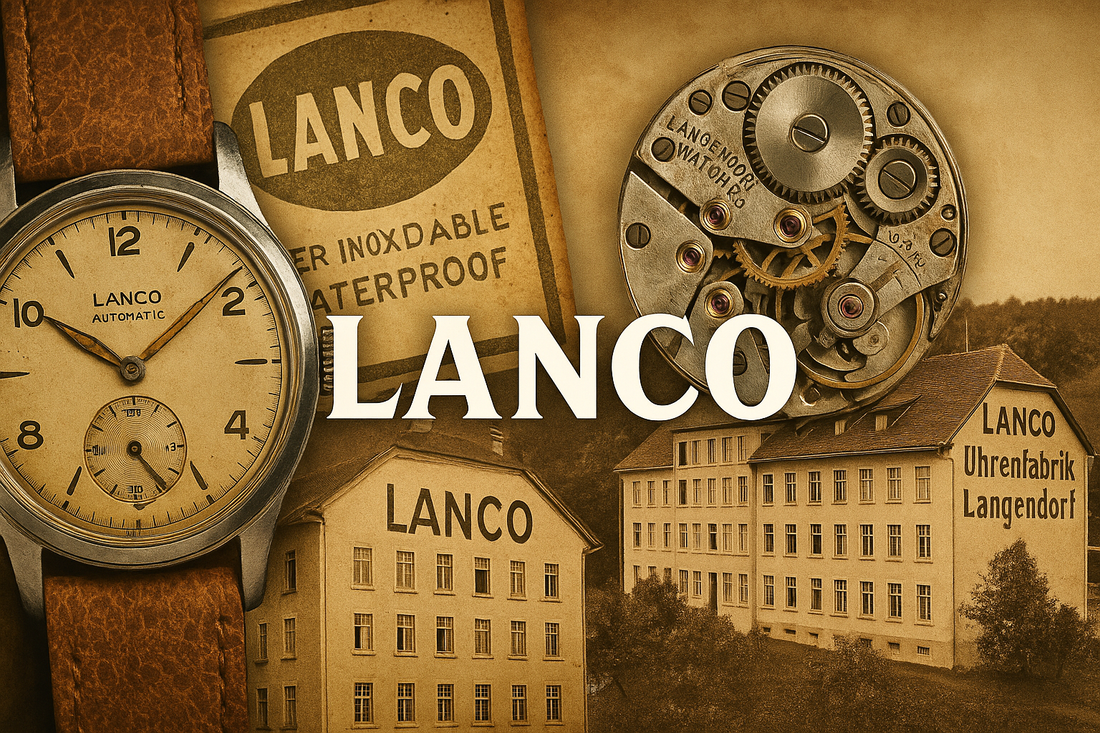
Within a few years, what remained of the glorious brand was dismantled and sold off. A division of Lanco linked to industrial automation (called “Lanco Economic”, specialized in assembly lines) was spun off as early as 1981 to form an independent company. The Lanco name was then passed in 1982-83 to an American company, Lanco Integrated, operating in the automated assembly sector. In effect, with this sale, all watchmaking activity linked to the Lanco brand ceased. The historic Langendorf factory was closed and converted: since 1977, part of it has housed a Migros shopping center, and in 2008, during renovation work, an old "LANCO" logo in reinforced concrete resurfaced briefly on the facade, before the last portion of the original buildings were demolished. A melancholy scene, almost the final farewell of a sleeping giant.
Rediscovered charm: Lanco and contemporary collectors

After production ended, the Lanco name fell into obscurity for a time. But the story didn't end there: today, decades later, Lanco is enjoying a second life in the hearts of vintage watch collectors. With the growing interest in vintage watches from the 1950s to 1970s, many enthusiasts have rediscovered these once-common timepieces and revalued them as true hidden gems. In specialized forums and enthusiast groups, Lanco is the subject of discussion and admiration. Some proudly display the Lanco that belonged to their grandfather, which sat in a drawer for years and then started ticking again after an overhaul; others boast of having found a vintage Barracuda at a bargain price at a flea market, knowing they've brought a piece of history back to light. A popular Italian watch forum has even launched a “census” of Lancos in personal collections, with dozens of users sharing photos and stories of their models – a sign that all of us (or almost all of us) have owned one or are looking for one.
The reason for this newfound appeal is twofold. On the one hand, Lanco watches perfectly represent an era : owning one means wearing a fragment of the 1950s or 1960s on your wrist, with all the history and nostalgia that comes with it. On the other hand, many Lanco models still offer exceptional value on the vintage market. For example, an original Lanco Barracuda—with a Swiss automatic movement and authentic historic diver's watch credentials—can be purchased for much less than prestigious contemporary diver's watches from more well-known brands. To ironically paraphrase a comment in an industry magazine, "If you don't have $13,000 for a Blancpain Fifty Fathoms Barracuda, a couple of thousand can get you a Lanco Barracuda!" And indeed, the Barracuda, once a "democratic diver," has now become a highly sought-after piece, with well-maintained examples fetching nearly and sometimes exceeding €1,500–€2,000 on the collector's market. Similarly, a Lanco-Fon in good condition allows you to own a rare mechanical alarm watch for a fraction of what a Vulcain Cricket would cost. Lanco chronographs with Valjoux movements, meanwhile, offer the allure of vintage complications without the astronomical outlays of more prestigious brands.
But beyond their economic value, what's attractive is the authenticity of these objects. Every Lanco bears the traces of its owner: scratches that tell of a life lived, dials beautifully patinated by time, mechanisms that tick tirelessly decades later. Collectors feel a true affection for Lanco because they feel they're saving a watchmaking heritage from oblivion. In a world where production is increasingly globalized and standardized, recovering a watch made in a Swiss village a century ago feels like a romantic gesture. It means giving new voice to that history made of chicory, workers, families, courageous innovations, and challenges won and lost.
Today the Lanco brand formally belongs to the Swatch Group (through acquisitions and subsequent steps) and is used for a line of watches intended for some smaller markets. But in the eyes of enthusiasts, Lanco isn't a logo to be exploited commercially: it's rather a symbol of bygone eras, a name that evokes a fascinating industrial epic and a product with a genuine soul. So, while we probably won't see new Lanco watches in jewelry store windows, we will increasingly see older Lancos on the wrists of proud connoisseurs. Every time one of these watches returns to tell the time, the story begins to live again: the ticking of a vintage Lanco is like a grandfather's tale, still capable of moving those who listen.
In conclusion, Lanco's story reads like a novel: there's a humble and surprising beginning, a dazzling rise, a peak of glory, and then a bitter decline, but finally a rebirth in the memory and passion of collectors. ChronoStories like this teach us that even defunct brands can live on, suspended between past and present, every time an enthusiast winds the crown and brings the mechanical heart of an old Lanco back to life.
credits: Wikipedia - wiki.grail-watch.com - castellowatches.com - www.ssongwatches.com - thenostalgiashop.co
original, unmodified images from Wikipedia archive CC BY-SA 4.0.