

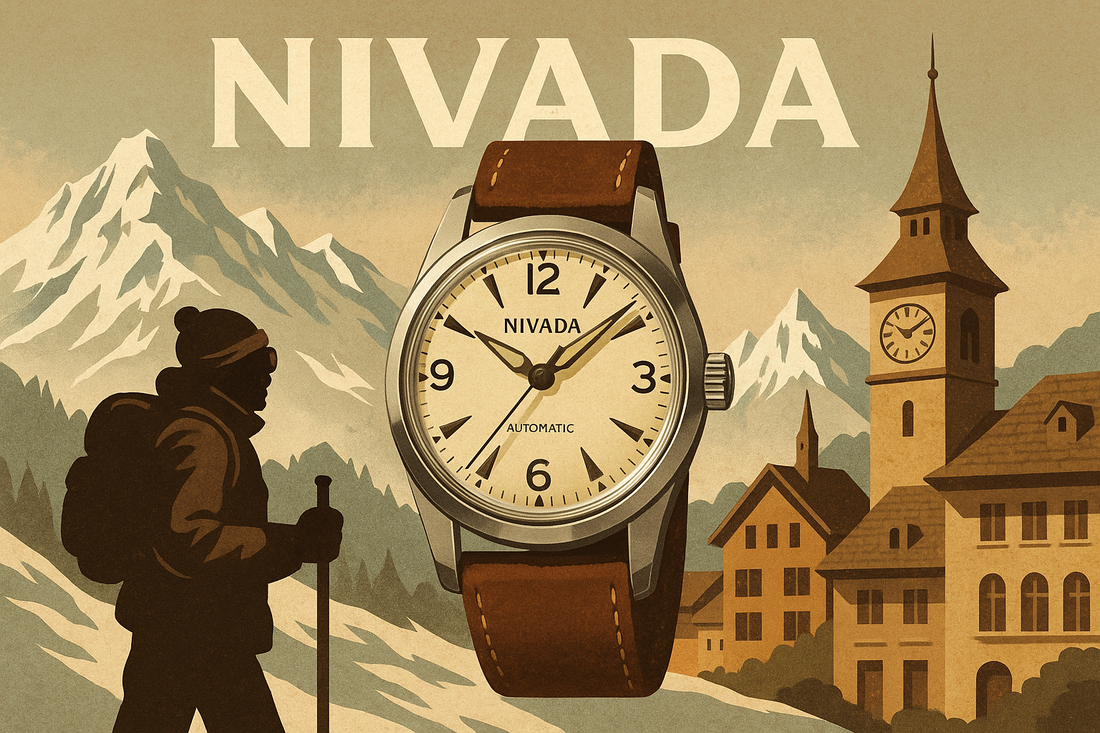
Nivada Grenchen: A Watchmaking Brand's History from Past Glories to Modern Rebirth
Share
Nivada Grenchen is a nearly century-old Swiss watch brand whose story has spanned glory, obscurity, and rebirth. Founded in the 1920s and pioneered many innovations in the 1950s and 1960s, Nivada disappeared during the quartz crisis, only to be revived in the new millennium thanks to the passion of visionary entrepreneurs. We retrace the fascinating history of this legendary brand—from its origins and successes, to the curiosities and recent relaunch that are marking a new era.
The origins of the Nivada brand (1926-1939)
Nivada is a Swiss watchmaker founded in 1926 in Grenchen, in the canton of Solothurn, by Otto Wüllimann, Hermann Schindler, and Jakob Schneider. Initially registered under the name Wüllimann, Schneider, Nivada SA, the company quickly specialized in the production of precise and functional watches, contributing to the development of the first self-winding models. By the end of the 1930s, Nivada had already established itself as a pioneer in waterproof timepieces and high-precision instrument watches, participating in national watch exhibitions as early as 1939. .
At the same time, the brand began to expand into foreign markets: as early as the late 1930s, Nivada entered into a partnership with the Croton Watch Co. of New York for the distribution of its watches in the United States. This partnership proved strategic, as later – due to a legal dispute with Movado over the similarity of the name – the brand was forced to adopt the name "Nivada Grenchen" from 1958. . In the USA, many models were then sold with the double “Croton Nivada Grenchen” branding on the dial, a commercial gimmick that allowed Nivada to maintain a presence in the rich American market despite trademark issues. .
Growth and innovation in the 1950s and 1960s
Polar Enterprises: Nivada Antarctic
In the post-war period, Nivada Grenchen's reputation grew considerably, also thanks to some military supplies: during the Second World War, the brand was contacted by the British government to supply watches to the troops, a recognition that strengthened the brand's notoriety in the following decades. In the 1950s, the company continued to diversify its production, ranging from elegant classic timepieces to robust technical watches for explorers and professionals.
The most famous model of this period is perhaps the Nivada Antarctic, an automatic watch launched in the mid-1950s and which became famous for having equipped Admiral Richard E. Byrd's Antarctic expedition as part of Operation Deep Freeze I (1955-56). These watches, advertised at the time as “waterproof, anti-magnetic and shockproof”, were actually used by the US Navy team led by Byrd and demonstrated extraordinary resistance in the extreme conditions of the South Pole. The success of the venture brought Nivada considerable international visibility, so much so that the company used the name “Antarctic” to christen an entire series of successful models marketed in the following years.
From Chronomaster to diving records
Another pillar of Nivada innovation was the famous Chronomaster Aviator Sea Diver, introduced in the early 1960s as a multi-purpose sports chronograph with a decidedly technical character. As its high-sounding name suggests, this model was designed for aviators as well as divers, combining in a single timepiece a tachometric scale for pilots, a rotating bezel for scuba diving and even a counter dedicated to sailing regattas. .
On the diving watch front, Nivada introduced further noteworthy innovations. As early as 1964, it presented the Depthomatic, one of the first automatic divers' watches with an integrated depth gauge, capable of guaranteeing water resistance up to 200 meters. . Just one year later, the famous Depthmaster debuted, capable of reaching depths of 1000 metres – an extraordinary record for the time, which would only be surpassed in 1978 by the Rolex Sea-Dweller 4000 (1200 m). Some versions of this model also featured a dial with unusually shaped numerical indexes, later nicknamed “ Pac-Man ” by collectors due to the shapes of the numbers 3, 6 and 9 which recalled the famous video game character. .
In the same decade, the maison did not neglect other complications: for example, it launched several watches with alarm functions (such as the Alertamic and Wanderer models, equipped with the Vulcain Cricket caliber), consolidating its reputation as a cutting-edge brand in providing reliable and robust, yet affordable timepieces. Nivada did not produce movements in-house, but rather used Swiss calibers supplied by third-party manufacturers (ETA, Phénix, Valjoux, A. Schild, etc.), thus guaranteeing mechanical quality at competitive costs. This philosophy allowed the brand to grow rapidly: by the late 1960s, Nivada was synonymous with professional watches with strong technical content but within the reach of a vast public of enthusiasts.
The Quartz Crisis and Decline (1970s)
The advent of quartz watches in the late 1970s posed a serious threat to the traditional watch industry, and Nivada Grenchen was no exception. Faced with competition from cheaper and more accurate Japanese quartz timepieces, the Swiss company struggled to adapt and had to gradually discontinue production towards the end of the decade. In 1976, coinciding with the 50th anniversary of its foundation, the leadership of the company passed from the last heir of the Schneider family to new owners, symbolically marking the end of a historic era for the brand. .
In the following years the brand changed ownership several times and lost much of its visibility on the market. A South Korean company (Kim Suk Keun Watch Company) acquired Nivada in the mid-1980s, orienting production almost exclusively towards quartz models; in 2000 the brand was then passed to the Mexican company Industrial Omega SA de CV, which registered the “Nivada Swiss” trademark and began marketing budget watches aimed primarily at the Latin American market. In fact, for over two decades Nivada survived only as a name placed on low-end products, far removed from the legacy of quality built during its golden age.
Yet the aura of Nivada Grenchen did not fade entirely. The brand's vintage watches—from the Chronomasters to the small Antarctics—continued to circulate among collectors and enthusiasts, keeping alive the memory of their ancient glories and testifying to the robustness and timeless appeal of these vintage models. .
The relaunch of Nivada Grenchen in the 21st century
Towards the end of the 2010s, the wave of rediscovery of vintage watches in watchmaking brought the Nivada name back into vogue. In 2018, two passionate entrepreneurs, Guillaume Laidet (already known for reviving historic brands) and Rémi Chabrat, acquired the rights to the brand and decided to revive Nivada Grenchen. Their vision was clear from the start: to recover the iconic models of the past and reinterpret them with a modern twist, while keeping the original spirit of the brand intact.
The first relaunched watches were faithful reissues of the great Nivada classics: the Chronomaster chronograph, the Antarctic model, and the indestructible Depthmaster diver, all enthusiastically welcomed by collectors and lovers of vintage watches. Thanks in part to social media buzz and word of mouth among the enthusiast community, the brand quickly regained visibility, finding a new audience beyond those nostalgic for the 1960s.
Subsequently, the new Nivada continued to expand its catalog by drawing on its rich historical archive. Models such as the Chronoking (a sporty chronograph from the 1970s, also available in more affordable mecha-quartz versions) and the elegant F77 from 1977, an automatic watch with an integrated bracelet inspired by the sporty chic style of those years, were brought back into production. In 2021, the Depthmaster line was also reintroduced in new versions, and in 2024 a new Chronosport saw the light of day, a chronograph with a typically 1970s design with a cushion-shaped case and two asymmetrical counters on the dial. These operations demonstrate the brand's desire to retrace all the glorious stages of its history, offering today's public pieces steeped in heritage but updated in performance and finishes.
Today, Nivada Grenchen has returned to producing Swiss-made watches that combine vintage aesthetics with modern construction. The successful relaunch of its historic models has renewed industry interest in this almost forgotten name. The brand's current strategy remains true to its roots: to continue developing timepieces that hark back to the past, while integrating contemporary technical innovations. Although reborn as an independent niche company, Nivada Grenchen is now once again recognized in the Swiss watchmaking scene, building on a tradition of technical daring, enduring designs, and craftsmanship that transcends the ages.
Curiosities about the Nivada brand
-
Origin of the name: Contrary to popular belief, "Nivada" is neither the founder's surname nor a geographical toponym, but rather a fictional name created for the company in the 1920s. To distinguish between possible names, in 1958 the entire brand name was changed to "Nivada Grenchen," a tribute to the Swiss city where the factory is located.
-
The dispute with Movado: In the United States in the 1950s, the Nivada name was considered too similar to "Movado," a famous competing watchmaker. A legal dispute ensued, forcing the Swiss brand to use a different name on the American market. Thus, the dials destined for the US featured the double signature "Croton Nivada Grenchen," a ploy that saved Nivada from losing that key customer base despite the trademark issues.
-
The Antarctic Watch: The Nivada Antarctic went down in history as the first watch to set foot on the South Pole. Supplied to the crew of the Operation Deep Freeze I polar mission in 1955-56, led by Admiral Byrd, this timepiece withstood extreme temperatures and demanding conditions, emerging unscathed from the eternal ice. In the wake of that mission, Nivada commercially exploited the Antarctic name for a successful series of models sold to the general public in the years that followed.
-
Depth Records: In the 1960s, as the "race to the deep" was raging among watchmakers, Nivada boasted a first: its Depthmaster diver's watch was one of the first watches in the world certified to reach a depth of 1,000 meters. For over a decade, no one beat that limit, until in 1978, a competitor succeeded in surpassing that limit. This achievement is a testament to Nivada's engineering excellence in professional diving watches and the pioneering attention to the durability of its timepieces.
-
An online rebirth: Nivada Grenchen's resurrection is a product of modern times. The new ownership has focused heavily on social media campaigns and engaging the online community to restore the brand's luster. For example, Nivada recently collaborated with the renowned magazine Hodinkee to reissue a rare 1960s Antarctic GMT model, updated with contemporary touches for today's collectors. Initiatives like this have further cemented Nivada's presence in the current scene, demonstrating how its historic legacy can still fascinate and inspire new generations of enthusiasts.
In conclusion, the story of Nivada Grenchen is a fascinating journey through nearly a century of watchmaking: from the pioneering intuitions of the 1950s and 1960s, to the darkness of the quartz crisis, to its brilliant rebirth in the new millennium under the guidance of passionate visionaries. Today, as in the past, this brand keeps the tradition of fine Swiss watchmaking alive, celebrating its own chrono-stories through every timepiece that leaves its workshops.
Credits: nivadagrenchenofficial.com - Wikipedia