

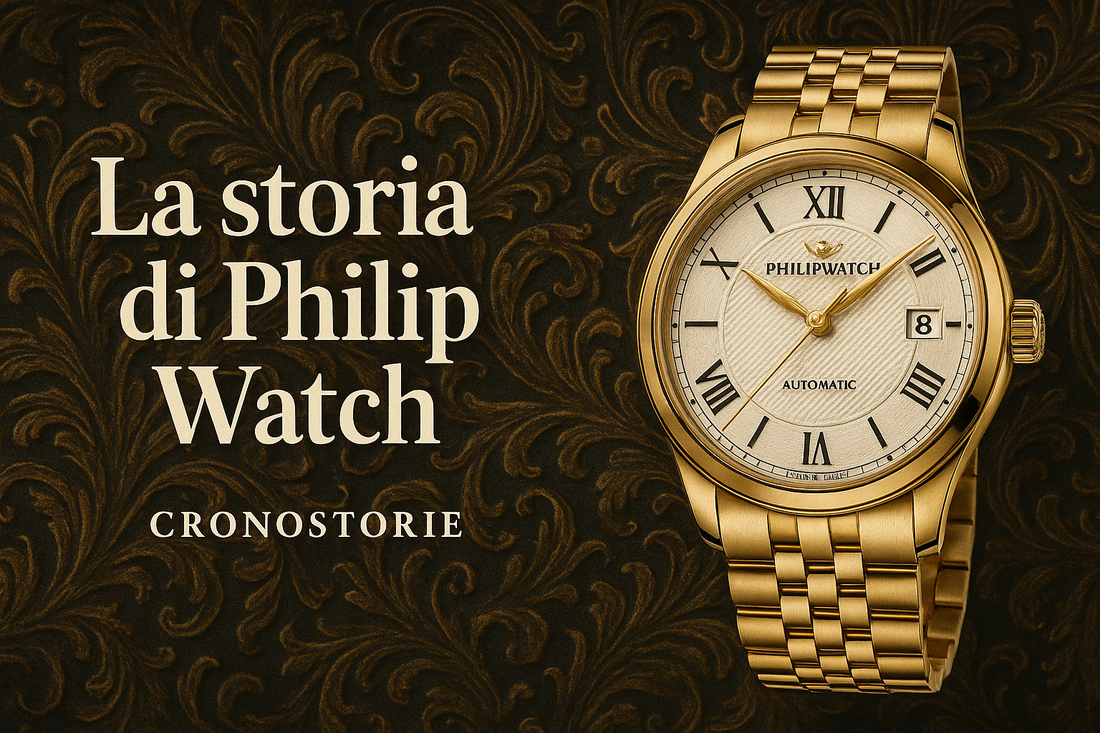
Philip Watch: The History of a Watch Brand Between Naples and Switzerland Since 1858
Share
Philip Watch is much more than just a watch brand: it's a journey through time that begins in Naples in 1858 and continues to the present day, intertwining tradition and innovation. In this article, we'll discover the fascinating history of Philip Watch, the oldest Italian brand of Swiss-made watches, from its Neapolitan origins to Swiss precision, from curiosities about its founders and iconic models to the recent successes that have relaunched its legend. Let's get ready to immerse ourselves in over 160 years of watchmaking excellence, told with fervor and emotion.
The Origins of Philip Watch: Naples 1858, a Meeting of Creativity and Precision
It all began in 1858 in Naples, then one of the busiest ports in Europe. Here, a Swiss master watchmaker named François Philippe joined forces with his Neapolitan colleague Filippo Giardiello to found an artisan watchmaking workshop. Naples, already a cosmopolitan crossroads, was home to a large Swiss community and offered the ideal terrain for this unusual collaboration. François Philippe, a prominent figure in the Swiss community living in Naples, embodied the perfect fusion of two worlds: he brought Swiss precision to the heart of Southern Italy, while Giardiello added Neapolitan creativity. Together, they created a winning combination of Neapolitan creativity and Swiss precision. , a formula that will become the distinctive feature of the brand.
In the early years the company dedicated itself to the production of elegant pocket watches, as was customary at the time. The duality has been present from the very beginning: watches born in Naples but made in Switzerland, taking advantage of the best of both countries in terms of design and technical construction. This dual nature made Philippe Watch timepieces—as the brand was initially called—known throughout Europe for their refined style combined with impeccable mechanics. Initial success pushed the small workshop beyond local borders, while the Swiss manufacturing guaranteed quality and reliability, essential elements for making a name for themselves in the world of late 19th-century watchmaking.
As time passed, the helm of the business passed to the next generation. François's son, Jean Philippe, continued the family tradition by moving the Maison to Biel/Bienne, Switzerland, which had meanwhile become the beating heart of the Swiss watchmaking industry. Here, the artisan workshop expanded into a fully-fledged company, with five generations of master watchmakers following one another in preserving and passing down the accumulated knowledge. It was during this period that a philosophy was formed that would remain intact over the decades: the technical heart in Switzerland, the creative heart in Italy. Philip Watch will continue to blend engineering and style, remaining faithful to the impeccable elegance of its origins. Even today, the brand proudly maintains this dual identity, preserving in its museum precious historical models that testify to the evolution of its style from its beginnings to today.
From the Foundation to the Postwar Period: A Name to Defend and a Heritage to Build
In the decades following its founding, Philip Watch consolidated its reputation in Italy and abroad. A crucial step occurred in the early decades of the 20th century : in 1923, the brand was officially registered in Naples under the name "Philippe Watch", thanks to the initiative of Filippo Giardiello, who had become the company's owner. This registration even predates the prestigious Patek Philippe, which had not yet registered its name in Italy. The very similarity of the name “Philippe Watch” with that of the Geneva-based maison, however, caused some misunderstanding among customers of the time: many associated the Neapolitan timepieces with the more famous Swiss watches, generating confusion on the Italian market.
To resolve the issue amicably, in 1947 (according to other sources in 1949) an elegant agreement was reached with Patek Philippe. Eduardo Giardiello, son of Filippo, with his typically Neapolitan courtesy, signed the agreement that would allow the Italian brand to continue to shine under a new, simplified name: “Philip Watch” was officially born, the definitive version without the final “ e” of Philippe. This choice allows the brand to avoid legal conflicts while preserving the homage to founder François Philippe in its name. It's a significant anecdote in the brand's history: from a potential dispute, a renewal in the name of continuity is born, and Philip Watch can continue its journey while preserving its identity intact.
After World War II, the brand – now known as Philip Watch – was able to focus on enriching its heritage of models and expertise. Collection after collection, remaining faithful to Swiss Made manufacturing, the company amassed a precious archive of designs and watches that today bear witness to its long history. Each new generation of watchmakers inherits not only the secrets of the trade, but also the mission of maintaining the brand's original character intact. This tradition, passed down from father to son, is one of the secrets of Philip Watch's longevity: for over a century and a half, the brand has managed to preserve its essence as an honest, solid, and down-to-earth brand, as defined by an Italian watchmaking historian. Even today, anyone who admires a Philip Watch perceives those values of quality and style unchanged over time, the result of a consistency rare in the watchmaking panorama.
The '60s and '70s: The Age of Divers and Retro Creativity
The 1960s arrived and Philip Watch was ready to ride the wave of technical innovation. At the end of the decade, the Maison presented its first professional diving watches, marking the brand's entry into the dive sector. Thanks to a collaboration with the Swiss brand Jenny, the revolutionary Caribbean technique was adopted, a sealed monobloc case system that guaranteed exceptional water resistance. . This is how legendary models such as the Caribbean 1000 and subsequently the Caribbean 2000 were born, capable – as the names suggest – of reaching depths of 1000 metres and more respectively in water resistance tests. These were incredible achievements for the time: just think that at the dawn of the 1970s, very few watches in the world could boast such operating depths. Some Philip Watch Caribbean models, recognizable by the small fish logo (Jenny's symbol) on the dial, were affectionately nicknamed "Caribbean Shark" by enthusiasts. – a nickname that perfectly evokes the aggressive and indomitable spirit of these abysmal watches.
Alongside its underwater endeavours, Philip Watch did not forget classic elegance and instead embraced it in a feminine key. It was precisely between the late 1960s and early 1970s that the Jolie Mode line was launched, dedicated to women and characterised by particular attention to refined design. As the world races toward modernity, Philip Watch celebrates timeless femininity with watches featuring refined shapes and elegant details, designed for women who want to wear a mechanical timepiece like a true jewel. Jolie Mode is an interesting anecdote: at a time when watches were still largely a men's affair (especially technical ones like chronographs or diving watches), the brand demonstrated sensitivity and foresight, offering models that anticipated fashion trends and brought a touch of sophisticated modernity to women's wrists.
In the 1970s, the brand's creativity continued to flourish. It was the decade of Cormoran, a collection born in the midst of experimental aesthetics. Philip Watch Cormorans boast oval-shaped cases, often described as "television-style" due to their characteristic square shape with rounded corners, which was in vogue at the time. This collection also has its distinctive symbol: a small cormorant in flight on the logo, parallel to the Caribbean fish. From a technical point of view, even without producing in-house movements, the company demonstrates its desire to offer the best to its customers: some Cormoran watches, for example, are equipped with the famous Chronomatic calibre, one of the very first automatic chronograph movements in the world. It's a connoisseur's detail that speaks volumes about Philip Watch's philosophy: despite relying on external suppliers for its movements (as was common for non-manufacturing brands), the brand chooses cutting-edge solutions, putting quality and innovation first. This dedication allows it to keep pace with the Swiss watchmaking giants and earn the respect of an increasingly large and demanding clientele.
The '80s and '90s: Between Tradition, Quartz, and Affordable Luxury
At the dawn of the 1980s, the global watchmaking industry was shaken by the quartz revolution, but Philip Watch faced the change without denying its identity. In this period, the company launched a new diving watch called the Seahorse, with more modern lines than the historic Caribbean, available in both time-only and chronograph versions. The Seahorse embodies the spirit of the 1980s: robust yet elegant, technical yet wearable. Alongside it, the Caribbean line continues to be produced, now coexisting with automatic movements called Philmatic or with the new, precise quartz calibers. It is interesting to note how some models from this period give a nod to a watchmaking icon: several Philip Watches from the 80s recall the style of the famous Rolex Datejust, for example showing off details such as steel-gold bracelets and date display that recall the Rolex design. These are stylistic tributes dictated by fashion, but created with personality: while drawing inspiration from the aesthetic canons of international luxury, Philip Watch maintains more accessible prices, thus managing to offer luxury and quality at a competitive cost. It is no coincidence that the brand's philosophy has always been to offer "fantastic value for money", that is, great value in relation to the price. , a characteristic that has contributed to its longevity.
The 1980s also marked the triumph of the two-tone style (steel and gold), and Philip Watch interpreted this trend with the Junior line (and its Junior Super variant). These models are both men's and women's, often compact in size, with round or contoured cases and, above all, with bracelets integrated into the case, without the traditional protruding lugs. This integrated design gives the watches a clean and harmonious look, much appreciated in the power dressing years. At the same time, the brand presents collections with an innovative spirit: one of these is Welkin, which adopts leather straps directly attached to the case (without lugs) in the wake of the success of Carlo Crocco's contemporary Hublot. The fact that a historic brand like Philip Watch looks to the most current trends – as it did with Welkin, taking inspiration from Hublot – demonstrates its ability to renew itself aesthetically while remaining faithful to its DNA.
During the second half of the 1980s, further lines appeared, designed to diversify the offering. The Letout collection, for example, offered elegant quartz watches equipped with useful complications such as a complete calendar, combining functionality and style. Then there is the Progressive line, composed of thin and sober quartz timepieces, perfect for those who prefer discretion and lightness on the wrist. Towards the end of the decade, Echo also debuted, a series of watches with a classic and very refined taste, which would be especially successful in the 90s. In every model from this period, Philip Watch's attention to reconciling tradition and evolution is clearly perceived: the materials change, quartz movements stand alongside automatic ones, but the attention to detail and timeless elegance remain unchanged.
As we enter the 1990s, Philip Watch reaffirms its historical link with the world of diving by presenting the Marine collection (1990). In it we find models such as the aforementioned Seahorse and above all the Sea Lion chronograph, spiritual heir of the Caribbean but updated to the needs of the time. As early as 1991, the Sea-Lion Chronograph was equipped with screw-down chronograph pushers – a technical solution designed to ensure greater water resistance – achieving water resistance of up to 500 metres. These professional diving watches confirm the brand's desire to remain a benchmark for those seeking robustness and reliability in extreme conditions. We are faced with timepieces that, in addition to being technical instruments, convey an idea of prestige : it is no coincidence that in the early 1990s the most prestigious Philip Watch models competed in the price range with high-end Swiss brands. A significant anecdote: a simple ultra-thin gold quartz Philip Watch, at the time, cost close to 2 million lire – comparable to a gold automatic Zenith – while a gold Sea Lion chronograph could exceed 7 million lire. These were significant figures, which positioned the brand at almost luxury levels, so much so that a gold Sea Lion with integrated bracelet cost as much as a prestigious gold IWC Portofino with perpetual calendar. . This data shows us how, before the modern era, Philip Watch was considered by experts to be a highly sought-after and high-profile brand on the market.
Between the mid-1990s and the dawn of the 21st century, Philip Watch embarked on new stylistic paths. Boldly designed lines such as Ixos, Imakos, Yeros, Reflexion, and Kelis were born, characterized by highly integrated cases and bracelets and sometimes futuristic shapes. This is a contemporary reinterpretation of the brand's aesthetic, aiming to appeal to a younger audience without alienating loyal customers. Meanwhile, for those who love underwater adventures, the powerful Teknodiver is presented: a generously sized chronograph with excellent readability, capable of withstanding depths of up to 1,000 meters. The Teknodiver takes the idea of the sealed monobloc case from the Caribbean patent and houses a robust Valjoux 7750 automatic movement, one of the most reliable chronograph calibers ever. This model represents an ideal bridge between past and future: on the one hand it pays homage to Philip Watch's diving tradition (recalling the glorious Caribbean), on the other it shows that the company is ready for the new millennium, with modern technology and a sporty spirit.
Before concluding the chapter on the 1990s, it's worth noting how Philip Watch managed to navigate the storm of the quartz crisis (which wiped out many historic brands in the 1970s and 1980s) by adapting without losing its identity. While introducing quartz watches and following trends, the company maintained high build quality and the allure of its classic design. This resilience has allowed Philip Watch to present itself strong and ready for the challenges of the new century, with a wealth of history and credibility that few others can match.
From 2000 to Today: The Revival of a Historic Icon
In the early 2000s, Philip Watch's fate crossed paths with that of major Italian watchmaking groups. In 2000, the Maison became part of the Sector Group, known for its sports watches, which acquired the historic brand and decided to focus on its relaunch. Under the Sector umbrella, Philip Watch benefits from new resources and distribution channels: it is in this period that the Aquatica 2000 collection was born, clearly inspired by the aquatic world and probably influenced by the success that Sector chronographs were enjoying on the market. The goal is to project Philip Watch into the new millennium while maintaining its DNA but speaking to a wider audience, perhaps even an international one.
The real change, however, occurred in the middle of the decade: in 2006, the entire Sector Group (and with it Philip Watch) was acquired by the Italian luxury group Morellato. Morellato, already the owner of prestigious brands, firmly believed in the historical value of Philip Watch and made it one of the flagships of its stable. From that moment on, the operational headquarters moved to Milan (where the brand also established a rich historical archive ), but the heart of production remained in Switzerland. The new management, led by CEO Massimo Carraro, adopted a smart strategy: enhancing the brand's long tradition without transforming it into something different. As Carraro himself explained, no one had ever tried to "fake" Philip Watch's history to make it more appealing: the brand's strength lies precisely in its authenticity and in the character built over 150 years, which should be protected and communicated, not altered.
In 2008 Philip Watch proudly celebrates 150 years since its foundation by launching the exclusive Anniversary 150 collection The Anniversary models feature retro lines (such as oval-shaped cases) as a tribute to vintage watches, and represent an ideal bridge between past and present. Ten years later, in 2018, another important milestone was reached: the brand turned 160. To mark the occasion, a commemorative timepiece was created in a limited edition of 160 pieces, based on the Sunray collection. This is an elegant 39mm automatic watch with power reserve indicator, with a vintage aesthetic but featuring water resistance up to 100 meters. A piece that perfectly embodies the Philip Watch philosophy: classic aesthetics, modern technical touches, and that attention to detail that makes each model timeless.
In recent years, Philip Watch has continued to renew itself by drawing on its historical heritage. The Grand Archive 1940 collection, recently presented as a tribute to the brand's historical archives, is emblematic in this sense. These watches feature classic 1940s styling, even sporting the original logo in period cursive on the dial. It's as if the Maison had opened its drawers of time, bringing to light drawings and projects from over half a century ago, to bring them back to life with contemporary materials and movements. The result is a success: Grand Archive 1940 wins over purists and new customers alike, demonstrating that innovation and tradition can go hand in hand.
Today, Philip Watch is a fully integrated brand into the global market, present in the most prestigious watch shops in Italy and abroad, yet without losing its connection to its origins. The traveling Philip Watch Museum initiative is emblematic in this regard: a selection of approximately 30 historic watches, from the 1940s onwards, exhibited at events and fairs, allowing the public to admire the brand's stylistic and technical evolution firsthand. Each piece in this collection tells a chapter in Philip Watch's history, demonstrating how the concept of timeless elegance has evolved through the ages. Heritage and innovation thus constantly intertwine in the company's present, in a balance that has been the common thread since 1858. .
A particularly significant moment was recently experienced in the brand's hometown. In June 2022, Philip Watch "returned to Naples" for a celebratory event entitled "A Wave of Life" at the Reale Yacht Club Canottieri Savoia, overlooking the Gulf of Naples. In this evocative setting, in the presence of Massimo Carraro (President of the Morellato Group) and guests and customers from Campania, the brand renewed its bond with the sea and sailing, elements that have always inspired its collections. Historic pieces from the Philip Watch museum were exhibited alongside new models launched for the occasion, such as the recent Caribe Diving and Amalfi, sports watches dedicated respectively to the underwater world and celebrating the Mediterranean lifestyle. “Philip Watch returns once again to Naples, the city where it all began, to renew its bond with the world of the sea and in particular with sailing, understood not only as a sport but also as a lifestyle,” Carraro declared during the event. . Excitedly, he added: “It is a great emotion to be able to tell the long history of Philip Watch in this splendid club where everything speaks of elegance and tradition, the same values as the brand." These words best sum up the current philosophy of the brand: looking to the future without ever forgetting the past, honoring its original values of elegance, tradition and ties to the territory.
From Naples to international showcases, Philip Watch's recent journey demonstrates that a historic brand can always write new chapters without betraying its soul. Today, as in the past, Philip Watch offers the world a concept of boundless and timeless elegance, projected into the future and driven by style. Its watches continue to combine Swiss precision and Italian creativity, in a unique combination that has stood the test of time. Whether it’s a classic timepiece from the Roma line or a modern Caribe Sport, each watch carries with it a bit of the magic of this long history, made of passionate craftsmanship, bold innovations and refined aesthetics.
Iconic Models and Curiosities of the Philip Watch World
Looking back at the history of Philip Watch, some models stand out that have left their mark more than others and deserve to be remembered as icons of the brand. Among these are undoubtedly the maison's two celebrated diving champions:
-
Caribbean 1000 (1960s) – An epochal watch, water-resistant to 1 kilometer It was one of the first timepieces in the world to achieve this record, thanks to its special patented monobloc case. The Caribbean 1000 consolidated Philip Watch's reputation among professional divers and enthusiasts, paving the way for generations of diver's watches in the brand's catalog.
-
Seahorse (1980s) – Introduced in the 1980s, it is a diving watch with a modern and recognizable design, featuring a particular knurled bezel that made it easier to grip. Also available in a chronograph version, the Seahorse combined robustness and style, becoming the benchmark for those seeking an elegant diver's watch. Collectors still remember it today as one of the finest examples of Philip Watch production from those years.
In addition to these, many other models and collections have contributed to the brand's allure. The Jolie Mode line, for example, remains in our memory as a synonym for femininity and sophisticated design in the 1960s and 1970s. The Cormoran collection represents the eccentric creativity of the 70s, with its TV-shaped speakers and the flying bird logo, a symbol of stylistic freedom. In the 1980s, the Junior series embodied the taste for two-tone designs and integrated bracelets, while the Welkin brought a touch of minimalist modernity inspired by emerging ideas in the sector. And how could we not mention the Teknodiver in the late 1990s, which, with its powerful construction and extraordinary water resistance, made the eyes of tool watch lovers shine?
An interesting fact concerns the founders and the brand's name: as we've seen, the company was born from the alliance between a Swiss and an Italian craftsman. The original name, Philippe Watch, was a clear tribute to François Philippe. Its postwar evolution into Philip Watch wasn't just a legal expedient; over time, it became an integral part of the brand's identity. Today, few remember this anecdote, and many might think that "Philip" was a fictitious name or the surname of an Anglo-Saxon entrepreneur. In reality, behind it lies the story of a gentleman's agreement between Naples and Geneva: a detail that adds to the brand's legend.
Another anecdote worth highlighting is Philip Watch's strong connection with Naples and the sea. It's no coincidence that numerous collections recall seaside locations or aquatic terms in their names: Caribbean, Coral, Mariners, and even the recent Amalfi and Capri. This maritime thread finds its explanation in the brand's emotional geography: born in a port city, shaped by the inspiration of the waves and travel, Philip Watch has a nautical and adventurous vocation in its DNA. As early as the 1950s and 1960s, the company produced watches for naval officers and navigators, and still sponsors sailing events today. Wearing a Philip Watch means wearing not only a quality timepiece on your wrist, but also a piece of history that smells of salt and tells of epic voyages.
In conclusion, the history of Philip Watch is a fascinating tale of encounters and balances: between Switzerland and Italy, between past and future, between elegance and performance. It is the story of a brand that, for over 160 years, has renewed its excellence every day. From the Naples workshop to the traveling museum, from diving records to glamorous lines, Philip Watch has transcended the centuries while always remaining true to itself. And the most extraordinary thing is that this story is far from over: each new model, each anniversary, each celebratory collection adds a chapter to a saga that continues to excite enthusiasts and collectors around the world. Philip Watch today is not only the oldest Swiss Made watch brand in Italy: it is a symbol of how passion, craftsmanship, and ingenuity can create something eternal, capable of defying time just like its hands.
In an age where everything moves so quickly, Philip Watch remains there, straddling the centuries, its ticking telling a ChronoStory made of men, dreams, and precious mechanisms. And every time we raise our wrists to check the time on a Philip Watch, we are actually reading a small fragment of this great adventure. An adventure destined to last, as long as there is someone willing to wind the spring of time and be fascinated by its eternal beat.
Credits: Wikipedia - Philipwatch.net